
Reviewed · OLD TOWN WALKING TOURS
Private History and Trivia Walking Tour by a Local Guide
A private history and trivia walking tour in Split is a smart way to see the city fast, without feeling rushed. You get a local guide to connect the big sights you already recognize with the stories that make them click, and you’ll reach some spots bus tours usually skip. The route focuses on the core of Diocletian’s Palace and the walkways around it, so you spend your time where Split’s layers of time are literally stacked on top of each other.
I love the way the tour turns landmark spotting into real understanding. My favorite part is the guide’s ability to answer questions clearly and go deeper when you ask, with humor that keeps the pace light even when the topics get serious. I also like how many small stops are built in, from the Bronze Gate experience to the Temple of Jupiter details and the ending viewpoint on Marmontova Street.
One consideration: this is a whistle-stop format, about 1 hour 45 minutes with a lot of walking and many stops. If you want long, unhurried museum time or extended photo breaks, you might need to pair this with another activity later in the day.
Key highlights to look for
- Private group up to 15 people, so you can ask questions and get real back-and-forth
- Diocletian’s Palace entry points like the Bronze Gate and Golden Gate, plus the substructures
- Religious transformations explained at St Domnius and the Temple of Jupiter, as Christianity spread
- Local trivia built around daily streets, including the narrow passage to Fruit’s Square
- A strong ending viewpoint on Marmontova Street overlooking the Croatian National Theater area
Why this Split private walk is a time-saver with real substance
Split is the kind of city where you can look at a stone wall for five minutes and still feel like you missed the point. This tour helps you avoid that. It’s designed for travelers who want a fast, guided way to connect names, dates, and layout to what you’re seeing right in front of you.
Because it’s private for your group (not a big cattle call), you’re not stuck waiting for the slowest person to catch up or for everyone else to settle down. And with a maximum of 15 people, the guide can still keep the rhythm moving without turning it into a blur. If you’re doing Split as a stop between ferry rides or a longer trip around Croatia, this kind of structure is a win.
I also like that the format does more than point at famous places. It’s built to give you Split’s “how it works” context, including local customs and practical city tips, which can save you time once the tour ends. You leave with a better sense of where to stroll next and what to prioritize if you only have one full day.
More walking tours of Split:
- Split: Old Town and Diocletian Palace Walking Tour
★ 4.9 · 4,727 reviews - Walking Tour of Split and Diocletian’s Palace
★ 5.0 · 2,588 reviews - Krka Waterfalls tour with Trogir Walking tour and Krka panoramic boat cruise
★ 5.0 · 1,659 reviews
Finding your starting point on the Riva promenade
Your meeting point is on Obala Hrvatskog narodnog preporoda 22, by the harbor promenade area in Split. This matters because you start with the waterfront context, not immediately inside a corridor of ancient stone.
At the beginning at Riva Harbor, you’ll look out and get oriented to the southern wall of Diocletian’s Palace, plus the harbor itself and both the eastern and western promenade/coast views. This first stop is short, but it does a big job: it helps you understand the geography. In Split, buildings and sea walls aren’t separate ideas. They shape the city, the street plan, and the flow of daily life.
If you’re the type who likes to photograph from the start, arrive a few minutes early so you can settle in before the group starts moving. The tour is timed in a way that keeps momentum, so you’ll benefit from being ready to walk.
Entering Diocletian’s Palace through the Bronze Gate substructures
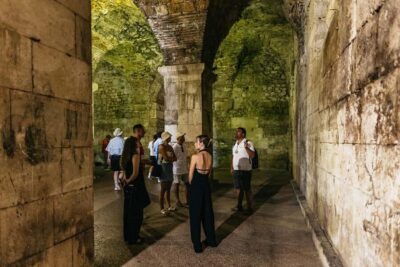
Next you move into one of the palace entry experiences: the southern entrance through the Bronze Gate, then into the palace substructures. This is one of the best contrasts in the whole route. From the outside, Diocletian’s Palace can look like a compact set of walls and arches. Inside, the substructures show you how the site functioned, and why people built it the way they did.
You’ll pass through the area and hear the specific role the substructures played through history as you go along. The practical value here is that you stop thinking of the palace as only a set of ruins. You start thinking of it as an engineered space designed to work, protect, and serve its inhabitants.
A possible drawback to consider: these are indoor or semi-indoor stone spaces, and the walk can feel tight in places. If you’re prone to motion sensitivity or you get uncomfortable in enclosed areas, you may want to take it slow at this portion.
The Peristyle: when the palace becomes a real square
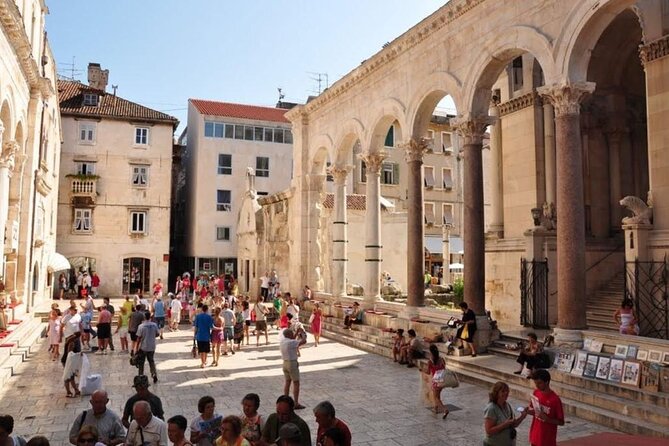
Then comes the central heart of the palace complex: the Peristyle and its Peristyle Square. This is where the tour shifts from stone architecture to human scale. A plaza like this is where people lived their days, hosted events, and moved between functions of the palace.
At this stop, the guide lays out the historical and cultural background of the site, so you’re not just looking at a postcard scene. You’re learning how the space fit into Diocletian’s world and later life in Split.
If you enjoy visual cues, watch how you’re surrounded by the palace structure. The tour is timed in a way that keeps you from lingering too long, but you still get a clear moment here to take photos and orient yourself for the next religious stops.
A few more Split days worth comparing
- Walking Tour of Split with a ‘Magister’ of History
★ 5.0 · 1,122 reviews - Split Walking Tour with Professor of History
★ 5.0 · 926 reviews - Split: History and Heritage Walking Tour
★ 4.9 · 650 reviews - Split History and Gastro Small-Group Tour with Food and Drinks
★ 5.0 · 375 reviews
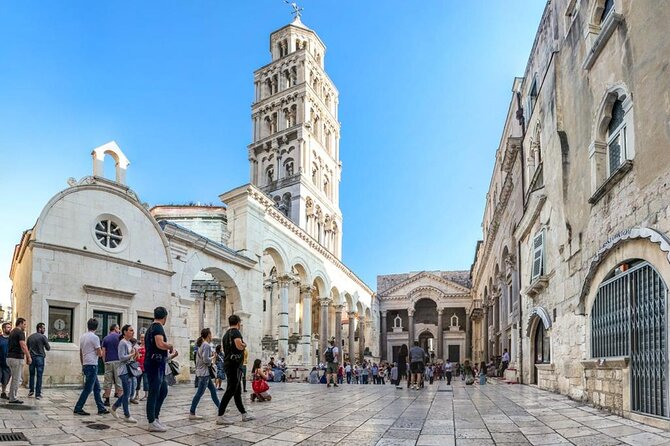
St Domnius Cathedral and the story of a mausoleum turned cathedral
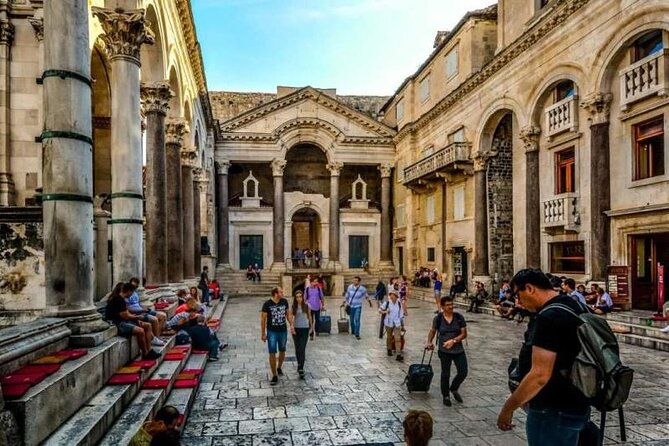
From the Peristyle Square, the tour moves into the area of the Cathedral of Saint Domnius. This stop is short, but the idea behind it is big: you’ll hear how the mausoleum of Emperor Diocletian became a cathedral as religious life changed over time.
The guide also explains construction style points connected to the cathedral and the adjacent bell tower. Even if you’re not a “church architecture” person, this works because it’s presented as a transformation story, not only a lecture about dates.
A useful tip: when you get to this area, look up and around. The contrast between ancient elements and later religious use is the point. The tour gives you the narrative, and then you can “read” the building with more confidence.
The Temple of Jupiter becomes a baptistery, plus the Sphinx detail
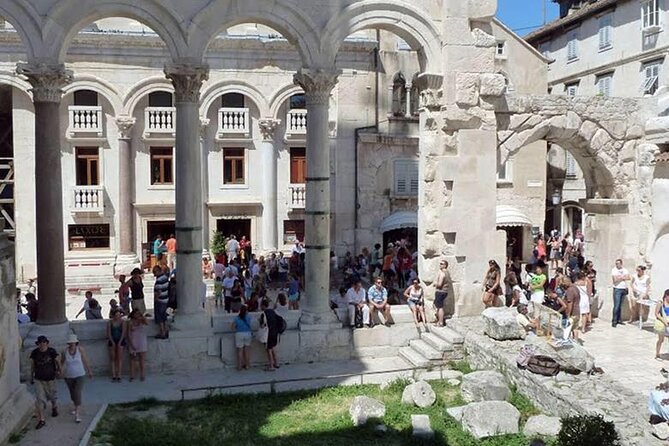
Next is the Temple of Jupiter, visited as you leave the Peristyle Square. You’ll hear how this temple was turned into a baptistery as Christianity spread inside the palace complex. That theme of conversion and repurposing shows up again and again in Split, and this stop gives you a clear example.
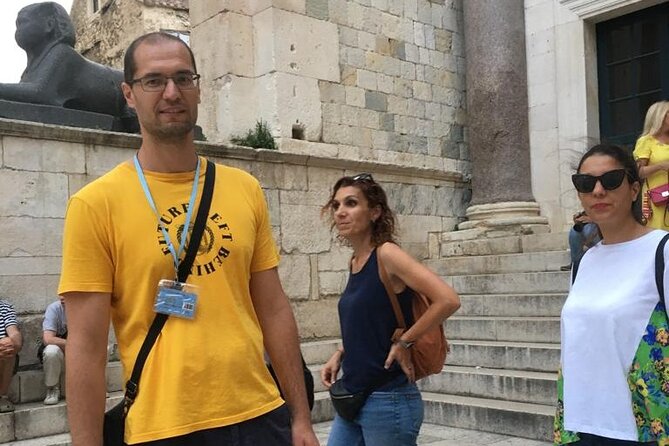
There’s also a standout detail: the Sphinx in front. The guide points out how it adds a stark visual presence, which is exactly the kind of moment you can miss if you’re walking on your own.
If you’re traveling with kids, this is a good stop to keep them engaged. Conversions of sacred spaces are easier to explain through story than through technical building terms.
Fruit’s Square, the narrow street, and the name Marko Marulić
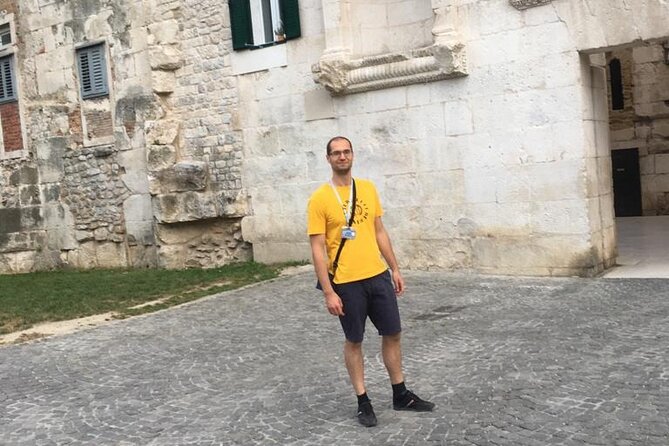
From there, you head to Fruit’s Square (Trg Brace Radic), moving through one of Split’s narrowest streets, the Pusti me Proć. That small stretch matters. In a city like this, the streets shape the experience, and a narrow passage changes your pace and your attention.
At Fruit’s Square, the guide talks about the development of Split and the lack of development at certain points in the past. You’re learning that the city wasn’t always the showpiece you see today. It grew into its current character through time, conflict, trade, and changing power.
The tour also passes the statue of Marko Marulić, described here as the father of Croatian literature. Right behind that, you’ll see the Milesi family palace from the 17th century. That pairing is helpful because it connects culture and “who lived here,” not just who ruled.
Narodni trg: the main square and the palaces of prominent families
Then you reach Narodni trg, Split’s main town square. You’ll get a historical look at how this square developed into the town’s central space. From there, you’ll spot renovated palaces and learn how the property ownership and architecture reflect the city’s shifting fortunes.
You’ll also pass references to older civic buildings like the old City Hall and palaces linked to noble families, including a palace connected to Korčula at one end of the square and other noble palaces along both sides. It’s like walking through a highlight reel of status, taste, and power.
This section is ideal if you like practical context. After hearing who lived where and why certain buildings matter, you’ll start noticing the city’s social geography on your own.
Zeljezna Vrata and iron gate history
Next up is Zeljezna Vrata, the palace’s western gate. The name itself, iron gate, hints at the sense of protection and control. Here, you’ll learn that this gate has a history with many different activities conducted there.
You’ll see the gate area and continue along the street passing several palaces tied to wealthy families. The route includes references to palaces built by the Cindro family in the 17th century and another belonging to a wealthy Italian family, the Augubio family from the 15th century. Even though these are fast glimpses, the guide helps you keep track of what you’re seeing and why it’s here.
If you want to photograph architecture, this is one of the better stretches. You’ll have enough stops to frame details, but the overall pace keeps you from losing the narrative thread.
City Museum of Split at Papalic Palace
The next short stop is the City Museum of Split, located in Papalic Palace. This is where the tour adds a pop-culture connection without losing the local anchor. You’ll get the building context, and then for Game of Thrones fans, you’ll hear that there’s an interesting, albeit bloody scene that takes place in front of the palace.
I like that the guide uses this moment as a bridge. You can be a fan of the screen version of a place and still learn what the building actually is, and what role it played in Split’s civic story.
The Golden Gate and the Roman craft you can still see
Another highlight is the Golden Gate, described as the northern entrance and the most decorated way into Diocletian’s Palace. You’ll notice the impressiveness of the way it’s built, and the guide points out how it reflects Roman building expertise.
This stop is a good example of why a guided walk helps. Without context, a gate is just a gate. With context, it becomes a clue to the priorities of the builders, the engineering skills used, and the aesthetic they wanted to present to visitors and residents.
If you have limited time in Split, don’t skip this section. It’s quick, but it teaches you what to look for.
Bishop Grgur of Nin and St Arnir’s bell tower
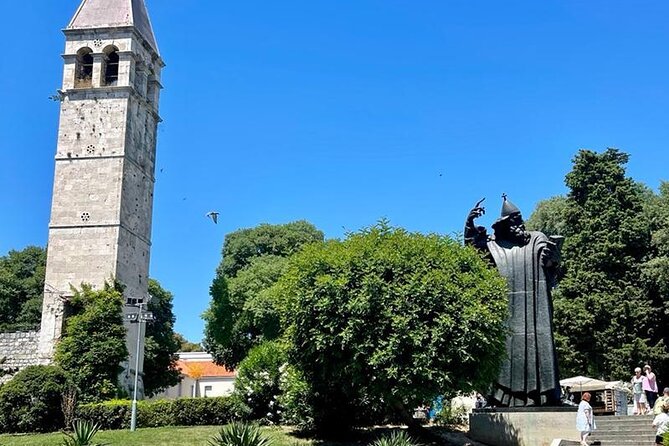
Opposite the northern gate, you’ll see the statue of Bishop Grgur of Nin, a work by the Croatian sculptor Ivan Meštrović. The guide explains why Grgur represents an important part of Croatian identity and religious story. This is one of the stops that helps you understand why Split matters beyond its Roman foundations.
Right beside that is the Bell Tower of St Arnir, including the chapel of Saint Arnir and remnants of an early Christian church. The guide gives a few words on what you’re seeing, but the main value here is that the tour keeps showing you how time layers keep adding new functions and meanings to older spaces.
Finishing on Marmontova Ulica for theater and church views
The last stop is Marmontova Ulica, where the tour ends near the top of the famous street with views over the Croatian National Theater area and the nearby monastery and church of Our Lady of Health. This ending viewpoint is more than a final photo moment. It gives you a big-picture understanding of how Split spreads beyond the palace walls.
When the tour finishes, it returns to the meeting point at Obala Hrvatskog narodnog preporoda 22, so you’re not stuck figuring out how to get yourself back across town.
If you want to extend your day, this is a great place to decide what you feel like seeing next. You’ve already learned the palace core, so now your instinct will be better about which directions feel right.
Price and what makes $53.95 feel fair
The cost is $53.95 per person, and the duration is about 1 hour 45 minutes. On paper, it’s not the cheapest thing you can do in Split. But the value is in three places.
First, you’re paying for a local licensed guide who can teach in multiple languages: English, French, German, Spanish, and Italian. Second, the tour is private for your group, with a maximum of 15 people, which usually means your questions get answered instead of being swallowed by a large group. Third, the route focuses on areas you can’t fully replicate with a quick self-guided stroll, including the palace substructures and the specific gate-to-square flow that makes sense once a guide tells you how the pieces connect.
You’ll also notice that admissions are listed as free for the stops covered here, so you should not be hit with extra entry costs during the walk. And the tour uses a mobile ticket, which is handy if you prefer not to manage printouts while traveling.
Timing, pace, and how to get the most out of the walk
This tour runs about 1 hour 45 minutes, and it’s structured as a fast series of stops. I’d treat it like a guided orientation first, then a launchpad for your own exploring after.
A few habits help:
- Arrive a few minutes early so you can start without stress.
- When the guide opens a stop with a question or a story, listen for the “why,” not only the “what.”
- If something catches your interest, ask a follow-up. The guide is set up to answer in depth, and that’s where the trivia part becomes useful rather than random.
The route includes a mix of open-air plazas and stone passages. Comfortable walking shoes help, since you are moving more than you might expect from just 13 stops.
Who should book this Split history and trivia walk
This is a great fit if you:
- Want a quick introduction to Diocletian’s Palace and the surrounding civic heart of Split
- Are short on time but still want context, not only photos
- Like history presented through real walking routes and transformation stories
It’s also a good family option. In past experiences with this style of tour, kids ages around five and seven have stayed engaged, and a 12-year-old reportedly enjoyed it too. Humor and clear answers seem to make a difference here, especially when the guide can tailor explanations in real time.
For solo travelers, the private format can feel personal. For couples, it’s efficient. For small groups, it’s controlled enough to stay easy while still moving through the highlights.
Should you book this tour?
Book it if you want a guided walk that helps you understand Split quickly. The strongest reasons are the combination of private pacing, the emphasis on Diocletian’s Palace as a living structure through time, and the guide style that keeps questions welcome. At this price, it’s not just “see stuff.” It’s “learn how to see stuff” for the rest of your trip.
Skip or rethink if you’re looking for a long museum day, or if you struggle with a tight walking schedule. This is for people who like a clear plan and a solid orientation, then freedom afterward.
If your ideal Split day starts with getting your bearings fast and turning ruins into stories, this is a very reasonable way to do it.
FAQ
How long is the Private History and Trivia Walking Tour in Split?
The tour lasts about 1 hour 45 minutes.
Where does the tour start?
The meeting point is Obala Hrvatskog narodnog preporoda 22, 21000, Split, Croatia.
Is this tour private?
Yes. It is a private tour or activity, and only your group participates.
What is the maximum group size?
The tour has a maximum of 15 persons.
What languages are available for the guide?
The guide is available in English, French, German, Spanish, and Italian.
Is a mobile ticket included?
Yes, the tour features a mobile ticket.
Are any admissions included or required at stops?
Admissions are listed as free for the stops included in the tour.
What are the operating hours?
The tour opening hours shown are Monday through Friday from 8:00 AM to 1:30 PM.
Is free cancellation available?
Yes, you can cancel for a full refund up to 24 hours in advance of the experience start time.
Fresh options around Split
- Walking Tour Split★ 4.7 · 61 reviews
- Unique vintage Tomos moped tour Split – Back to the ’80s★ 4.8 · 17 reviews
- Essential Diocletian’s Palace Tour for First-Time Visitors★ 4.8 · 19 reviews
- Split: Trogir Open Top Bus Trip + Free Split Walking Tour★ 4.1 · 17 reviews
- Ranch 22 Podstrana, ” Horse riding 12 km from SPLIT “★ 4.5 · 79 reviews
- Zinfandel Wine Tasting & Storytelling with Dalmatian Food★ 5.0 · 20 reviews
- 1 st Waterbike Safari in the World★ 5.0 · 23 reviews
- Full-Day Quad and Wild Horses Safari in Livno from Split★ 5.0 · 12 reviews
Old Town Walking Tours, compared.
Walking Tour of Split and Diocletian’s Palace
Read our review →
Krka Waterfalls tour with Trogir Walking tour and Krka panoramic boat cruise
Read our review →
Walking Tour of Split with a ‘Magister’ of History
Read our review →
Plitvice Lakes: Guided Walking Tour with Train and Boat Ride
Read our review →
Diocletian Palace & Old Town Guided Walking Tour
Read our review →Browse the lists this tour appears in