
Reviewed · TROGIR TOURS
Trogir walking tour with a local guide
A Trogir walking tour works because it compresses centuries into a tight route, so you can place what you see instead of just snapping photos. You get a local guide and a small-group pace, and the town quickly starts to make sense.
I love the bell-tower views from St. Lawrence Cathedral, with sightlines over Čiovo, the mainland, and the Adriatic. I also love the personal stories guides add, like the kind Daniella and Kristina share when they connect art and architecture to real life in Trogir.
One consideration: pacing. The tour is listed at about 1 hour 30 minutes, but it can feel brisk if you are trying to linger in every square, especially on a hot day, so plan your energy accordingly.
Key highlights to look for on this Trogir walk
- St. Lawrence Cathedral focus, including Radovan’s Portal and panoramic bell-tower views
- Venetian civic landmarks, from Town Hall to the Town Loggia
- Plague-era gratitude at St. Sebastian’s Church, plus its clock tower context
- Palace Cipiko and Renaissance remodeling, tied to Niccolò di Giovanni Fiorentino
- A sea-side finish on the Riva promenade, ending with Kamerlengo Castle
- A tight small-group format in English, ideal for getting your bearings fast
Why Trogir is built for a guided walking tour
Trogir Old Town is the kind of place where you can wander for an hour and still feel like you are lost in a maze of stone lanes. That is exactly why a guided highlights walk helps. You do not just pass landmarks, you get the why behind them, so the town’s layout and style start clicking.
This tour is also a nice length for first-timers. At around 90 minutes, you are not stuck all afternoon, but you still cover enough ground to build a mental map. The group stays small, capped at about 15 people, which makes it easier to ask questions when something catches your eye, like a portal’s carvings or a church façade that looks different from the last one.
The biggest value, in my opinion, is the human layer. Guides such as Daniella, Kristina, Blanka, and Christina are local, and they bring family stories and personal context into the buildings. When that happens, the town turns from scenery into a place with memory.
More walking tours of Trogir:
- Krka Waterfalls tour with Trogir Walking tour and Krka panoramic boat cruise
★ 5.0 · 1,659 reviews - From Split: Krka Waterfalls Cruise & Trogir Walking Tour
★ 4.7 · 681 reviews - Trogir: City Highlights Guided Walking Tour
★ 4.9 · 199 reviews
Timing, meeting points, and how the 90 minutes really feel
You meet at Ul. Gradska vrata 5 in Trogir, and you end at Obala bana Berislavića, near the waterfront. The route is designed as a straightforward old-town loop, and the stops are spaced to keep things moving.
With a listed duration of about 1 hour 30 minutes, you should expect a steady pace and a lot of “look closely” moments. Most stops are short photo breaks, and a few are quick transitions between one historic layer and the next. That can feel perfect if you want an efficient introduction, but it may feel tight if you love lingering.
Also, this experience requires good weather. If you get a clear day, great, because the views are part of the payoff. If it is hot, bring water and give yourself permission to slow down only at the stops that matter most to you, like the cathedral bell tower or the promenade at the end.
St. Lawrence Cathedral: the big story starts in 1213
St. Lawrence Cathedral is the centerpiece, and it earns that role. Construction began in 1213 and took five centuries to reach its final form. That long timeline matters, because you can actually sense how styles evolved across the building’s life.
Inside the context you get on the tour, the cathedral is described with three naves and a blend of Romanesque and Gothic touches. Even if you do not know the terminology, you will recognize the mix in how the space feels and how the details are shaped.
Then comes the moment that makes people smile: the bell tower viewpoint. You get panoramic views over Trogir, across to the island of Čiovo, out toward the mainland, and across the Adriatic Sea. This is one of those photo stops where the explanation helps, because you can orient yourself to what you just walked through.
If you are the type who likes structure, not just decoration, this is your stop. The cathedral gives you a time-and-style backbone for everything else you see.
Radovan’s Portal, carved by Master Radovan

Just as important as the cathedral itself is Radovan’s Portal, the main entrance sculpted and carved by Master Radovan, a medieval craftsman from Trogir. This is a piece of 13th-century artistry with a very specific claim to fame: it is described as a unique sculptural work from the first half of the 1200s.
Why I like this stop so much is that it teaches you how to look. Instead of treating the façade like a backdrop, the guide’s focus encourages attention to the shapes and figures, and to the fact that this town had serious artists working locally long ago.
Also, the portal is not tucked away. It is presented as the main entrance, so you naturally see it early in the walk, which makes the rest of the old town feel more intentional. You are not just collecting highlights, you are following a theme: craftsmanship, civic pride, and the layers of Trogir over time.
More Trogir departures and old-town time:
- Split/Trogir: Blue Cave, Mamma Mia, Hvar and 5 Island Tour
★ 4.6 · 6,320 reviews - Blue cave, Mama Mia and Hvar, 5 island speedboat tour from Trogir
★ 5.0 · 2,861 reviews - Krka Waterfalls Day Tour with Boat Ride from Split and Trogir
★ 5.0 · 2,134 reviews - Krka National Park Tour with tour Guide & Wine tasting from Split & Trogir
★ 5.0 · 1,625 reviews
John Paul II Square: the best kind of people-watching stop
John Paul II Square, known locally as Trg Ivana Pavla II, is one of those open-air pauses that feels like an urban living room. Around it sit some of Trogir’s most important buildings, and the square is often taken over by café tables and umbrellas.
The tour’s stop here is short, but it is well placed. You take in the architecture, then you get the chance to slow down. If you want a practical takeaway, this square is a good place to do that reset: grab a coffee or an ice cream, check your bearings, and let the scale of the old town settle in.
There is something genuinely relaxing about this part of the walk because you are not staring at a single monument. You are watching how historic space still works for everyday life, which is exactly what you hope a guided introduction will help you notice.
Town Hall staircase and courtyard coats of arms

Next up is the Town Hall built in the 15th century. The details here are easy to miss if you are just speeding by, so the guide’s timing matters. The building has an elegant courtyard decorated with coats of arms, and outside you get a staircase that is called one of the most striking examples of Venetian architecture in Trogir.
The value of this stop is less about memorizing dates and more about understanding the town’s civic identity. Town Halls like this one are where local authority showed itself, not through speeches, but through stone. When you understand that, you see the stairway and courtyard as more than pretty features.
If you are traveling with a group that has different interests, this stop also works. Architecture lovers get the Venetian look. Everyone else gets a “this is how cities organized themselves” moment.
St. Sebastian’s Church and the plague story

St. Sebastian’s Church and Clock Tower has a clear narrative hook. The church was built in 1476 by Trogir’s citizens who were grateful to be delivered from the plague. That single fact changes how you see the building. You are not only looking at a religious structure, you are seeing a community response.
The tour also connects the church’s design to architect Niccolò di Giovanni Fiorentino, known in English as Nicolas of Florence. That is one of those useful links guides sometimes provide: it helps you place Trogir inside a wider network of Renaissance-era talent.
This stop is typically kept to about 10 minutes, so do not plan to read every detail like it is a museum placard. Instead, use it as a story anchor, then move on with the right question in your head: what did this town fear, survive, and build as a result?
Town Loggia: where citizens gathered and laws were proclaimed
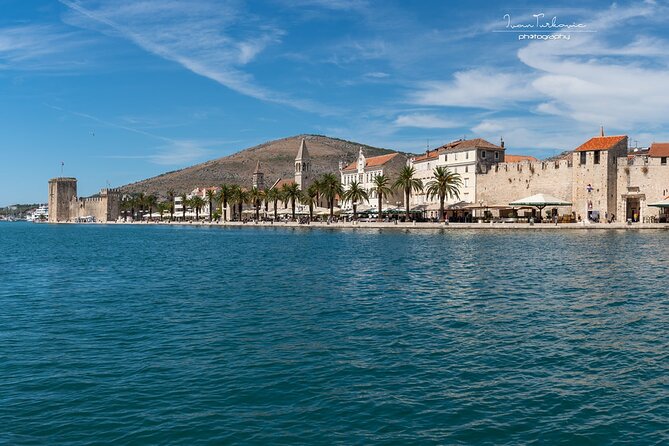
The Town Loggia dates back to the 13th century and is described as a covered space next to the clock tower. This was where citizens used to congregate to discuss issues of the day. On certain days, it was also where the local court met to proclaim laws and handle cases.
I like this stop because it is a reminder that public life is not modern. When you stand in a loggia like this, you can picture the tempo of older civic life, people gathering under a roof to talk, decide, and make things official.
It also balances the religious and palace-heavy parts of the route. You have cathedrals and noble buildings, then suddenly you are thinking about daily administration and community debates.
If you want your photos to mean something, look for lines and shadows under the covered structure. The loggia changes the feel of the street right around it.
Palace Cipiko: Romanesque roots plus Venetian Renaissance remodeling
Palace Cipiko is presented as a group of Romanesque buildings that later took on a Venetian Renaissance look between the 15th and 17th centuries, after extensive remodeling. The guide also connects Niccolò di Giovanni Fiorentino to this palace, including the note that he carved the south portal.
Even if you are not a serious architecture person, this is a satisfying stop because you can actually feel the transitions when a building is reshaped over time. It is not just one era frozen in place. It is a history of owners, tastes, and ambitions.
And if your timing is right, you will also see how the town’s palace world extends into museum territory. The route notes that you will step into Trogir Old Town through the North Gate and then see the museum housed in a series of palaces once owned by the Venetian family of Garagnin-Fonfogna.
That North Gate moment is useful because it tells you where the old town’s walls and entry points fit into the story. After that, the palaces feel less random.
Church of Our Lady of Mount Carmel and the fishermen’s connection
In the western part of Old Town, off the waterfront promenade, you get the Church of Our Lady of Mount Carmel. The guide frames it as historically the church of Trogir’s fishermen, craftsmen, and laborers. That specific focus helps you avoid the common tourist mistake of treating every church as just another pretty façade.
If you happen to be in Trogir on 16 July, the tour points out an evening tradition tied to this church: a traditional procession with the statue of Our Lady. If you are not visiting in July, you still get the value, because understanding who a church served shapes how you interpret its role in the neighborhood.
This stop is a good reminder that the town’s heritage is not only about nobles and architects. It includes the trades and the everyday workers who built the city’s real momentum.
The Kairos bas-relief: a small sculpture with a big message
On the route, you will also come across a bas-relief featuring a young man standing on tiptoe, ready to fly away instantly. The image describes outstretched arms, scales in his hands, a tuft of hair falling over his forehead, and a bald crown. The meaning offered here is the idea of seizing the right moment when it arrives, because Kairos will fly away if you hesitate.
I like this stop because it turns art into a practical reminder. You can see the town as a series of monuments, or you can see it as a set of lessons people once carried in stone.
It is brief, but it sticks. Later, when you look back at the cathedral, palaces, and civic buildings, you start thinking about urgency and timing, not just dates.
Riva promenade and Kamerlengo Castle: where the sea closes the loop
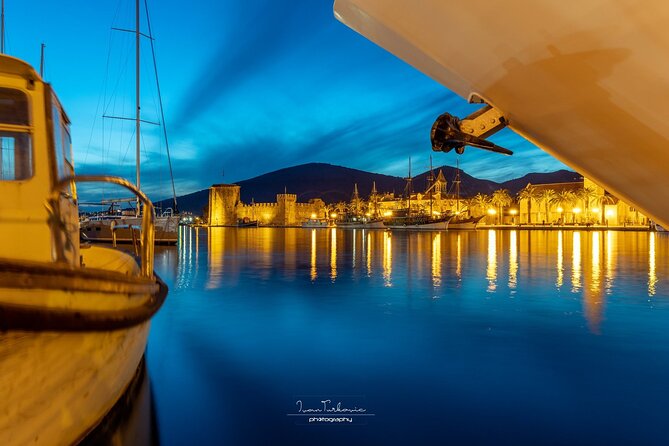
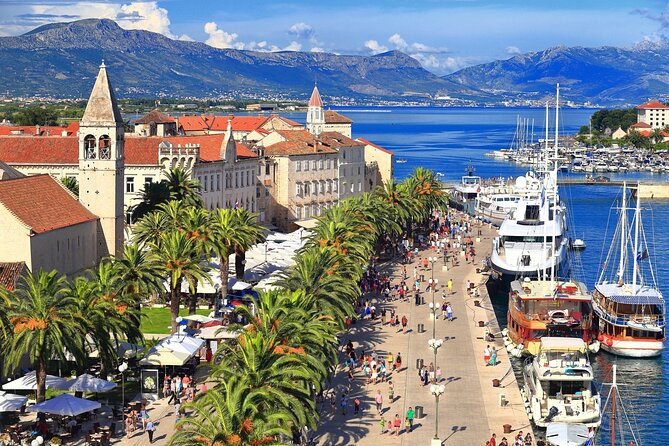
The walk finishes with Trogir’s waterfront promenade, called the Riva by locals. The description is specific: wide, flat, and straight, palm-fringed, and running along the water edge. From here, you get splendid views across the sea channel to the nearby island of Čiovo.
This section is valuable because it transitions you from stone to horizon. You also get a sense of why this town was so connected to the sea, not just geographically, but economically and culturally.
At the end of the promenade sits Kamerlengo Castle, an early 15th-century fortress positioned on a corner of the tiny island that holds the Old Town. Right nearby, you will see a local football pitch and a small playground, plus stalls linked to tour operators.
That mix of historic fortifications and everyday recreation is a fitting close to the route. Trogir is not a theme park. It is a functioning town with history layered underneath daily life.
What makes this tour feel excellent: the local-guide storytelling
The biggest thing I would bet on here is the guide quality. A common thread in the feedback is how calm and easy the tours feel, yet how informative they are. People praise guides for teaching without turning it into a lecture.
The local aspect is the real engine. Guides such as Daniella and Daniela are singled out for sharing family experiences growing up in Trogir and for explaining history with a personal lens. Kristina is highlighted for enthusiasm and for blending town history with real-life growing up details, including references to local schooling.
You also see guides connecting broader Croatian history to what you are standing in. One account notes a guide shared perspectives tied to growing up through the Homeland War, which adds emotional context you just do not get from a printed placard.
And importantly, the best guides keep you engaged. Multiple descriptions point to interactivity and pace control, with guests feeling they stayed focused the whole way. For many people, that is the difference between a tour that feels like a checklist and one that feels like a true introduction.
If you book this, do one small thing to maximize value: ask your guide a question that starts with what life was like back then. The town’s buildings become easier to understand when you hear how people used them.
Price and value: is $18.14 a good deal for 90 minutes?
At $18.14 per person, this tour sits in that sweet spot where you are paying for focused interpretation, not just access. You are getting an English-speaking guide, a small group size up to 15, and a route that hits multiple headline sights in a compact timeframe.
For value, think of what you would otherwise do. If you tried to stitch together the same highlights yourself, you would spend time figuring out where to go, in what order, and what to notice once you got there. Even a basic cathedral and waterfront combo can become expensive if you end up paying for extras you do not need. Here, the focus stays tight.
The fact that people book it about 16 days in advance also tells you it tends to fit into planning timelines. It is popular enough that you should reserve soon, especially in peak season.
Just be honest with yourself about expectations. This is not a half-day crawl with long museum time. It is an efficient overview with strong storytelling. If you want the full slow-browse version, pair this with one or two longer returns to the places that capture your attention most.
Who should book this Trogir walking tour
This works best if you want:
- A clear first pass through Trogir Old Town in about 90 minutes
- A guide who connects architecture to people and local life
- A route that includes cathedral views, civic landmarks, and the sea promenade
It might not be your best match if:
- You hate walking and want to avoid any time on your feet
- You want a slow, linger-at-every-corner pace, because the structure is built for momentum
I also think it is a great “first or second day” plan. It helps you decide what to revisit later, because you come away knowing what each place is actually about, not just what it looks like.
Should you book this Trogir walking tour?
Yes, if you want a smart introduction to Trogir that blends major sights with local context. The cathedral and Radovan’s Portal portion gives you big visual payoff, and the later stops, from civic buildings to the Riva promenade, help you understand how the town works as a lived-in place.
Book it early in your trip, when you still need orientation. Bring water if it is hot. And if timing feels like it runs closer to a shorter window than expected, use that as a cue to prioritize, take your photos, and ask the guide one or two questions while you are there.
FAQ
How long is the Trogir walking tour?
It is approximately 1 hour 30 minutes.
How much does the tour cost?
The price is $18.14 per person.
Is the tour offered in English?
Yes, it is offered in English.
Where does the tour start and where does it end?
The start is Ul. Gradska vrata 5, 21220, Trogir, Croatia. The end is Obala bana Berislavića, 21218, Trogir, Croatia.
What is the group size limit?
The tour has a maximum of 15 travelers.
What happens if the weather is poor?
This experience requires good weather. If it is canceled due to poor weather, you will be offered a different date or a full refund.
Fresh options around Trogir
- Blue cave & Hvar (5 Islands) private tour from Split or Trogir★ 3.5 · 7 reviews
- Blue Lagoon and Trogir town half day – private speed boat tour from Split★ 5.0 · 7 reviews
- Blue Lagoon and Trogir town – half day speed boat tour★ 4.0 · 5 reviews
- Blue Lagoon and Trogir town – half day speed boat tour★ 4.5 · 23 reviews
- Blue Lagoon, Trogir & Čiovo catamaran tour with Food and Drinks★ 4.5 · 15 reviews
- Private Luxury Boat tour for 12 from Split, Brac, Trogir, Hvar★ 5.0 · 65 reviews
- All inclusive luxury Krka waterfalls trip from Split or Trogir.★ 5.0 · 5 reviews
- Adriatica Tour ( Blue Lagoon and Solta) from Trogir or Split★ 5.0 · 17 reviews
Trogir Tours, compared.
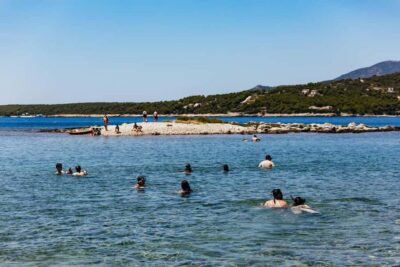
Blue Cave, Mamma Mia, Hvar and 5 Island Tour
Read our review →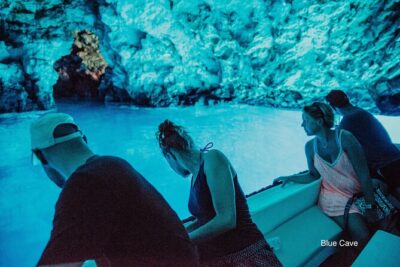
Blue cave, Mama Mia and Hvar, 5 island speedboat tour from Trogir
Read our review →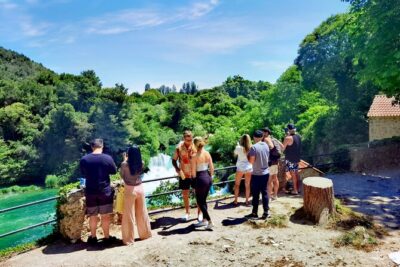
Krka Waterfalls Day Tour with Boat Ride from Split and Trogir
Read our review →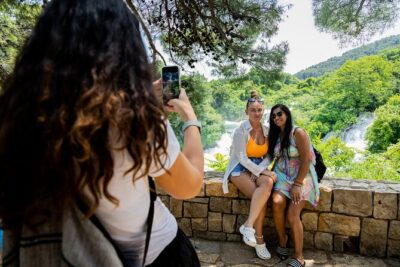
Krka Waterfalls tour with Trogir Walking tour and Krka panoramic boat cruise
Read our review →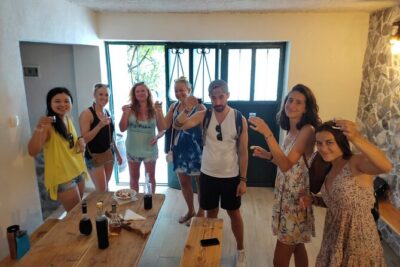
Krka National Park Tour with tour Guide & Wine tasting from Split & Trogir
Read our review →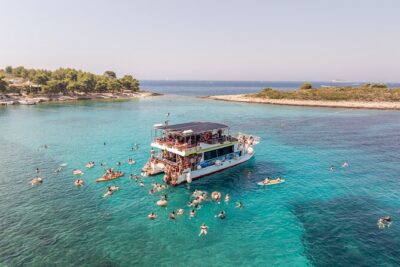
Hvar, Brač & Pakleni islands cruise with lunch & drinks from Split & Trogir
Read our review →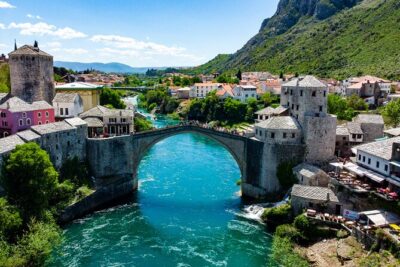
Mostar and Herzegovina Tour with Kravica Waterfall from Split & Trogir
Read our review →
Browse the lists this tour appears in