
Reviewed · OLD TOWN WALKING TOURS
Split Walking Tour with Professor of History
Split’s Old Town can feel like a maze until you have a guide who can explain what you’re actually looking at. This Split Walking Tour with a History Professor turns the streets of the city into a timeline you can follow, from everyday seafront life to imperial Roman architecture at human scale.
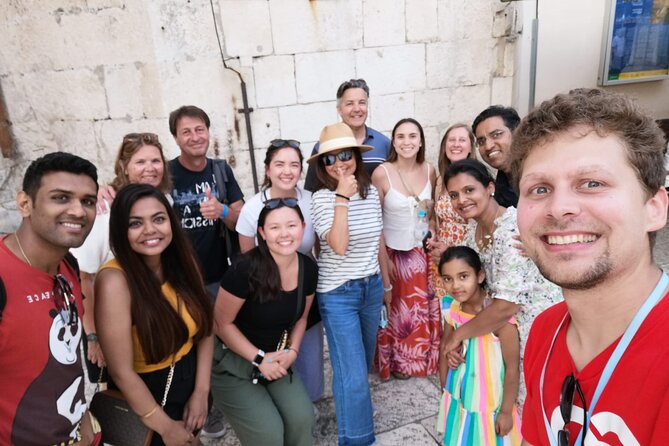
I especially like two things. First, the tour balances big-ticket sights like Diocletian’s Palace with lived-in corners such as the Riva promenade. Second, the pace works because it’s a small group (up to 17), and guides like Mario and Anita clearly enjoy teaching, answering questions, and mixing humor with the facts.
One consideration: you’ll learn the history of the Cathedral of Saint Domnius and the Temple of Jupiter, but you’ll generally view them from the outside because entry isn’t included. Also, while the tour runs about 2 hours 20 minutes, I’d plan for it to stretch a bit if your guide adds extra context.
Key Points You Should Know Before You Go

- Professor-led storytelling that connects Roman rule to what you see in the streets today
- Small group size (max 17) that makes questions and follow-ups actually feel possible
- A well-paced route through Diocletian’s Palace highlights like the substructures, Peristyle, and the Rotonda vestibul
- Outside-focused coverage for the Cathedral of Saint Domnius and the Temple of Jupiter, with optional add-on time if you want inside views
- Old Town stops beyond the palace, including Riva, the Golden Gate area, Marmontova Ulica, Prokurative, and Fruit Square
- Strong practical value for first-timers, especially with English guides and free stop access for most locations
Why This Split Tour Clicks in Real Life
What makes this tour work is the order of sights. You start with the places locals actually use, then you walk into the palace zone and feel the shift from street life to imperial power. You’re not just looking at stones, you’re learning why those stones were placed there and how that history shaped modern Split.
I also like that the guiding style tends to match the subject. A professor is good at turning dense history into plain language, and the best moments come when a guide points at something physical and explains how it functioned. That gives you context fast, so you can enjoy Split even after the tour ends.
The route is also designed to hit the highlights without requiring a stack of extra tickets. Many stops are free to access during the walk, which keeps the day from turning into paperwork and lines.
More walking tours of Split:
- Split: Old Town and Diocletian Palace Walking Tour
★ 4.9 · 4,727 reviews - Walking Tour of Split and Diocletian’s Palace
★ 5.0 · 2,588 reviews - Krka Waterfalls tour with Trogir Walking tour and Krka panoramic boat cruise
★ 5.0 · 1,659 reviews
Starting at Brass Gate (Porta Aenea) and Riva Harbor
Your tour starts at Brass Gate (Porta Aenea) on Obala Hrvatskog narodnog preporoda. It’s a solid anchor point because from there you can quickly understand where you are in the old town web, rather than wandering in circles before you even learn the basics.
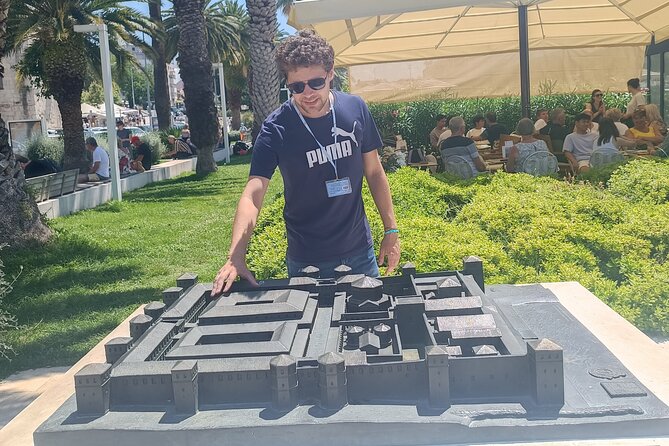
From the start, you move to Riva promenade, right by a model of the palace. This is one of my favorite “first feelings” in Split. It’s where locals hang out, grab coffee, and spend time in the sun, so it sets a human baseline before the Romans start flexing their architecture.
A possible drawback here is that the seafront portion can be busy at certain times. The good news is that the tour uses the early segment to build orientation, so even if you’re weaving around people, you’re gaining something.
Diocletian’s Substructures: The Palace Below the Palace
Next you get into one of Split’s most impressive layers: the Diocletian Palace substructures, often called the basement halls. This area is famous because it’s among the world’s best-preserved complexes from classical antiquity, and it’s one key reason Split’s historic center earned UNESCO World Heritage status in 1979.
In plain terms, you’re learning to see the palace as something built for both power and daily movement. The substructures help you understand that the “palace” was not just one grand room. It was a whole functional world underneath, built to support life, access, and authority.
If you like archaeology and architecture, this stop is a standout. If you don’t, it still helps, because the guide’s explanation gives you a way to connect underground spaces to the surfaces you’ll see later.
The Peristyle: Where Imperial Life Gets Performed
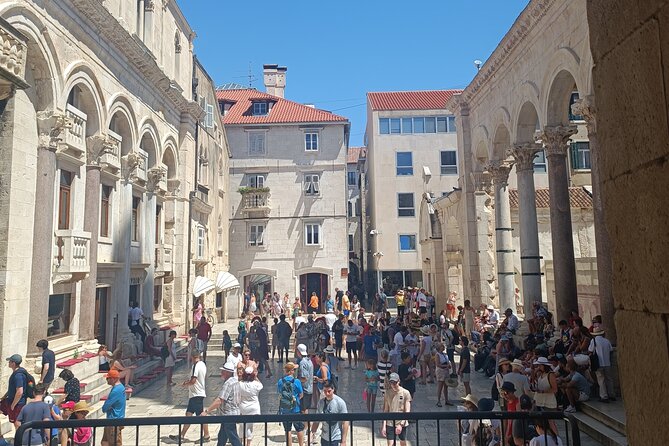
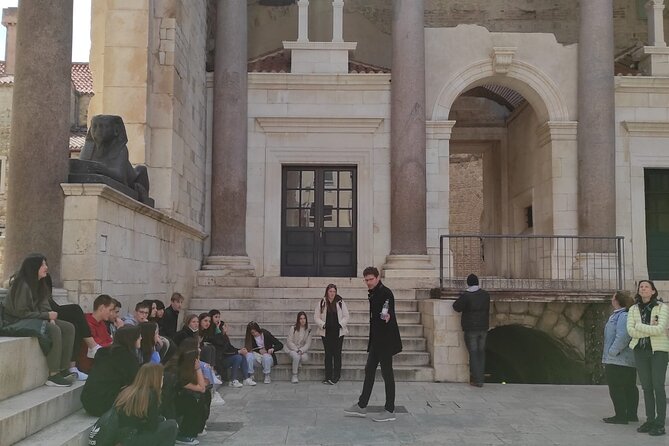
From underground, you step up into the drama of the palace core at the Peristyle, the central square of Diocletian’s Palace. The Peristyle wasn’t just pretty. It was meant to be a stage for the emperor, where people approached, knelt, and performed rituals tied to the idea of the ruler as a near-divine figure.
The guide’s job here is to make you notice details you might otherwise miss, like how entrances, movement, and sightlines would shape behavior. It’s a strange feeling, watching the square through modern eyes and then imagining it as a court.
This part of the tour rewards patience. Try to slow down, look up, and let the explanation do its work. Even a short stop becomes useful when you understand what the space was designed to communicate.
A few more Split days worth comparing
- Walking Tour of Split with a ‘Magister’ of History
★ 5.0 · 1,122 reviews - Split: History and Heritage Walking Tour
★ 4.9 · 650 reviews - Split History and Gastro Small-Group Tour with Food and Drinks
★ 5.0 · 375 reviews - SPLIT-PREMIUM Emperor’s Walking Tour for History Lovers + Museum
★ 5.0 · 333 reviews
The Vestibul (Rotonda): The Palace’s Formal Reception Mode
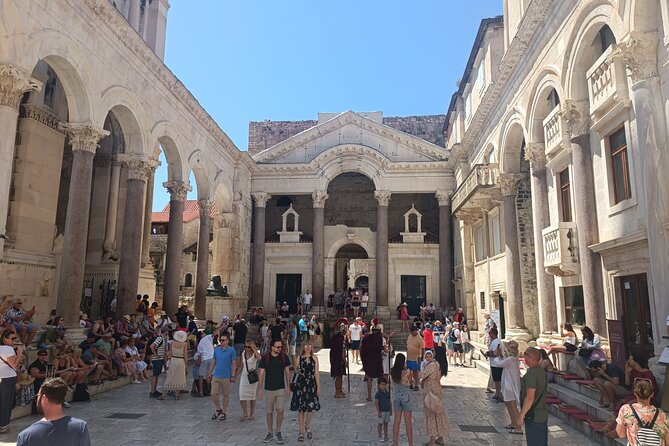
Then you move to the Vestibul, also known as the Rotonda, which is the first section of the imperial corridor leading from the Peristyle. This is the formal entrance feeling of the palace, where only selected audiences would enter.
The Rotonda is a circular hall built up to the beginning of the 4th century. It’s described as having once had a dome, roughly 17 meters high and 12 meters in diameter, and it was designed as a grand meeting hall for audiences like ambassadors. You can see why a ruler would want a space like this. It controls emotion, movement, and attention.
Drawback note: because this is a walking tour, you won’t have a long time to simply wander around. So go in expecting explanation first, photos second, and use your guide’s pointers to get the most from the short time window.
Cathedral of Saint Domnius and the Temple of Jupiter, Outside Only
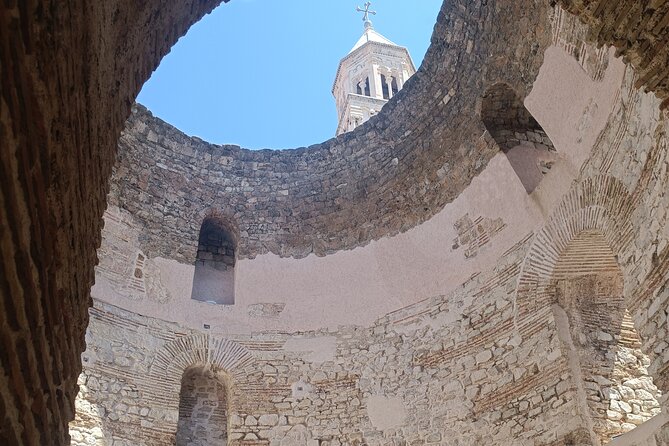
The tour then turns to two religious landmarks tied to Roman origins, but with a specific limitation you should understand up front.
At the Cathedral of Saint Domnius, you’ll get the layered story: it’s often described as a Roman temple and mausoleum that later became a church. You’ll be able to visit and look around from the outside, with detailed information provided during the tour, while entry is not included. If you want to go inside, your guide can help you decide, but you’ll need to purchase admission separately.
Next is the Temple of Jupiter. Jupiter was the supreme god in Roman religion, and later the temple was converted into a baptistery dedicated to St. John the Baptist. Again, you’ll view it from outside only, with no included entry.
If you’re the type of traveler who really wants interior details, plan your day so you can return on your own. If you’re more interested in understanding what these buildings represent, outside viewing is still enough, as long as the guide’s explanations land.
The Golden Gate, the Narrow Street, and Old Town Direction Sense
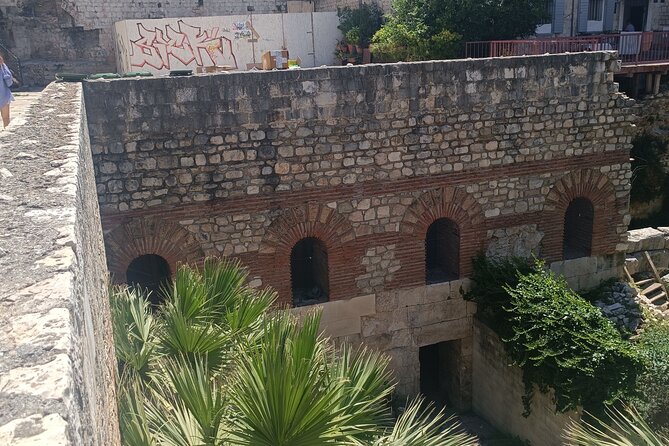
After that, you head toward the Golden Gate, also called the Northern Gate. This was one of the four principal Roman gates into the old town of Split, built as part of Diocletian’s Palace. It served as the main gate through which the emperor entered the complex and was originally decorated to mark its status.
Over the Middle Ages, the gate was sealed off, and it lost columns and statuary. In modern times it was reopened and repaired, and it now works as a tourist attraction you’ll see at the end of the story of palace access.
On the way to the next location, you’ll walk through a small street locals believe is the narrowest in the world, known as Let me pass street. This is the kind of stop that looks like a quick side note until you remember what a city is made of. Narrow streets and sudden turns are how you feel the age of a place.
Gregory of Nin (Grgur Ninski) and Marmontova Ulica
Next is the tall, famous statue of Gregory of Nin by Ivan Meštrović. The statue is 8.5 meters tall, and the toe is famously worn smooth from generations of visitors rubbing it for good luck. It’s one of those moments where history and popular ritual collide, and that mix is part of why Split stays memorable.
From there you walk down Marmontova Ulica, a beautiful street named after Napoleon’s marshal Marmont. It’s a reminder that Split’s history isn’t just Roman, medieval, and then modern. You also get layers from later European powers, and city names can be the clue.
This stretch also helps you shift back into “walking around mode.” The palace zone is intense and concentrated, and these streets give you breathing room to let your brain process what you just learned.
Prokurative and Fruit Square: Civic Life, Culture, and Food Stories
The tour finishes at two spaces that help you understand the city’s public life after the palace.
First you reach Prokurative, also known as Republic Square. It’s a large open square with elaborate neo-Renaissance buildings surrounding it on three sides. This is where civic and social energy shows up in stone, not just in old temples and gates.
Finally, you end at Fruit Square (Trg Brace Radic), a small square where fruit sellers used to gather. This stop is more than charming. It’s a great place for stories that connect culture with everyday routines, and it sets you up to think about what to eat and where to wander next.
Your guide ties in figures like Marko Marulić, described here as the father of Croatian literature. It’s a clever way to broaden the story beyond architecture, so you leave with a stronger sense of Croatian identity, not only Roman influence.
Price and Time: Getting Value in Under Half a Day
The price is $24.19 per person for about 2 hours 20 minutes (approx.). For a tour that covers multiple major sights inside and around Diocletian’s Palace, that’s pretty fair, especially because most stops have free admission tickets during the walk and the total includes all fees and taxes.
A practical value check: you’re paying for interpretation. These are not “look and go” stops, because the difference between simply seeing a gate and understanding why it mattered is huge. A history professor helps you turn the day into context you can use immediately.
That said, you should plan timing honestly. While the tour is advertised around 2h20, I would allow up to 3 hours if your guide adds extra context or the group moves more slowly. If you have tight dinner plans, aim for a bit of buffer.
Also, this tour is booked on average 33 days in advance, so if your dates are firm, you’ll do yourself a favor by reserving earlier rather than later.
What You Get Included, and What You Might Pay Later
Included in the tour price is all fees and taxes. You’ll get a mobile ticket, and the tour is offered in English. The tour also lists alcoholic beverages as not included, which is typical for walking tours.
Two other items are important for planning your budget and expectations. The Cathedral of Saint Domnius and the Temple of Jupiter are covered from the outside, and entry is not included. If those interiors matter to you, make a plan to return or add time on your own.
Most other palace and old town stops in the route are free during the walk, so you are less likely to feel nickeled-and-dimed.
Who This Tour Fits Best
This is a strong choice if you:
- are in Split for the first time and want a fast orientation through the old town core
- like history that connects buildings to daily life, not just dates on a timeline
- want a guide who can handle questions and keep the group moving
- appreciate a small group format where you can actually hear explanations
It’s less ideal if you:
- hate walking in heat or crowds
- need long inside visits for major sites, since the cathedral and Jupiter temple are outside-only here
- expect a strictly rigid schedule, because the pacing can flex based on what your guide wants to explain
If you’re traveling with kids, it can still work because the guiding style tends to use stories, but you should expect a lot of standing and looking. Bring water and wear comfortable shoes.
Should You Book This Split Walking Tour With a History Professor?
I’d book this tour if you want to understand Diocletian’s Palace and the surrounding streets without spending your first day guessing. At $24.19, with English guidance and most stops free during the walk, you get a lot of payoff for a short time.
It’s also a great “set you up for the rest of your trip” option. Guides like Mario and Anita are described as proud of Croatian heritage and quick to recommend what to do next, including where to eat around the old town area. That kind of guidance matters when you want to wander with confidence after the tour ends.
If your top priority is entering every major interior, then consider pairing this with a follow-up visit on your own. Otherwise, this tour is one of the most practical ways to turn Split from confusing stone into a story you can follow.
FAQ
How long is the Split walking tour?
The tour is listed at about 2 hours 20 minutes.
How much does the tour cost?
The price is $24.19 per person.
Is the tour in English?
Yes, it is offered in English.
How many people are in the group?
The tour has a maximum of 17 travelers.
Where does the tour start and where does it end?
It starts at Brass Gate (Porta Aenea) on Obala Hrvatskog narodnog preporoda 22, Split, and it ends back at the meeting point.
What is included in the price?
The price includes all fees and taxes.
Are alcoholic beverages included?
No, alcoholic beverages are not included.
Do I get entry into the Cathedral of Saint Domnius or the Temple of Jupiter?
Visits to both are from outside only, and entry is not included.
What if the weather is bad?
The tour requires good weather. If it is canceled due to poor weather, you will be offered a different date or a full refund.
Is free cancellation available?
Yes, you can cancel up to 24 hours in advance for a full refund.
Fresh options around Split
- Small-Group Communist Tour of Split – Boutique group tour★ 5.0 · 7 reviews
- Controversies behind Split and Croatia-Anthropologist guide★ 5.0 · 59 reviews
- Split City Tour By Electric Rickshaw┃Riva Ride★ 5.0 · 50 reviews
- Coffee, storytelling & walk – The best private tour of Split★ 5.0 · 46 reviews
- Chill Private Walking Tour of Diocletian’s Palace★ 5.0 · 35 reviews
- Canyoning basic on Cetina river from Omiš★ 5.0 · 66 reviews
- River Rafting from Split- Cliff Jumping- Cave Visit★ 5.0 · 90 reviews
- Private Split City Walking Tour – Spanish Guide★ 4.5 · 12 reviews
Old Town Walking Tours, compared.
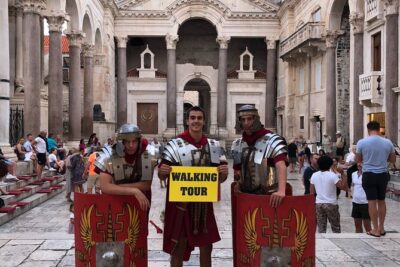
Walking Tour of Split and Diocletian’s Palace
Read our review →
Krka Waterfalls tour with Trogir Walking tour and Krka panoramic boat cruise
Read our review →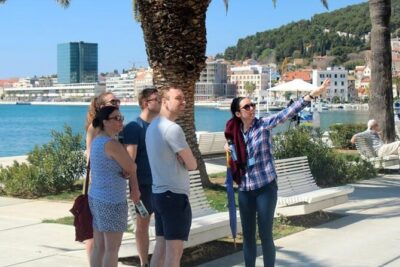
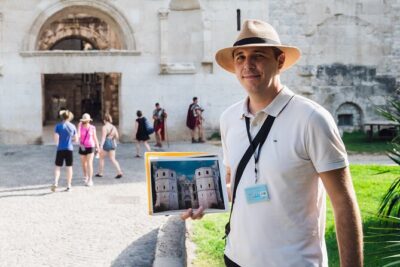
Walking Tour of Split with a ‘Magister’ of History
Read our review →
Plitvice Lakes: Guided Walking Tour with Train and Boat Ride
Read our review →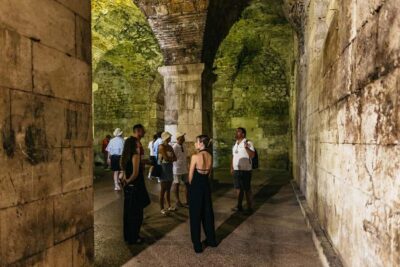
Diocletian Palace & Old Town Guided Walking Tour
Read our review →
Browse the lists this tour appears in