
Reviewed · OLD TOWN WALKING TOURS
Split Private Walking Tour for Families with kids from 5-17 years
A family private walk through Diocletian’s Palace is a great way to make ancient history feel real for kids. The tour is built like a game, with tasks, puzzle-style moments, and a little treasure hunting to keep attention where it should be.
What I love most is the kid-friendly pacing. You get short stops spread across the palace, the waterfront, and the city squares, so you are not stuck in one long, tired stretch. A second win is the included snack, chocolate tasting, which is a simple way to keep energy steady during 2.5 hours.
One thing to consider: this is a good-weather walking experience. You are on stone streets and in open-air areas, so plan for sun, wind, and occasional crowds inside the palace area.
Key highlights to know before you go
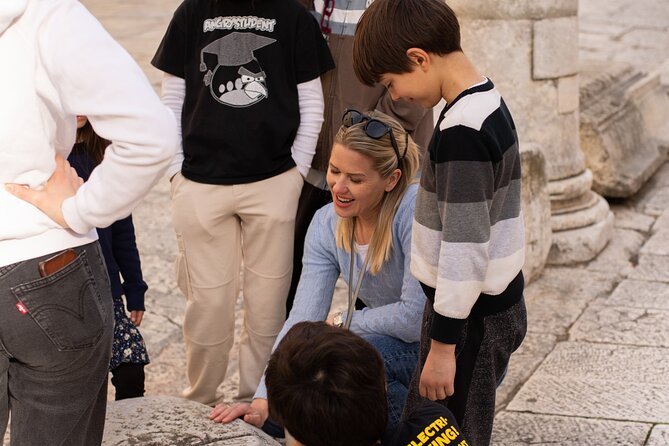
- Private group (up to 6) for families with kids ages 5 to 17, so the guide can adjust on the fly
- Diocletian’s Palace is the main event with entry included and kid-focused challenges
- Chocolate tasting is included, and soda is not, so you may want water
- Short, varied stops (harbor, substructures, cathedral, gates, squares) keep the day moving
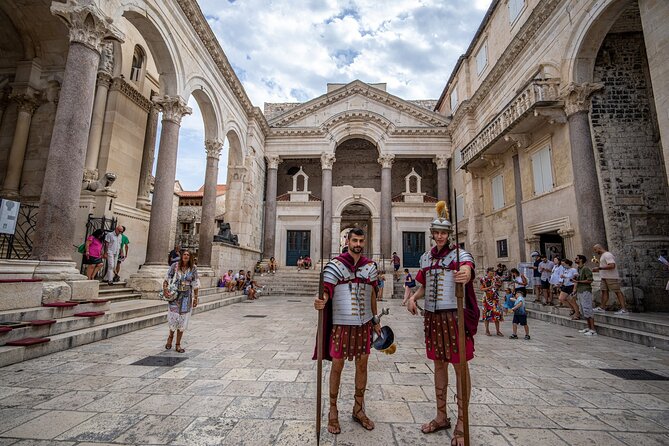
- Your route includes classic Split icons like the Peristyle, Temple of Jupiter area, and the main gates
- English mobile tickets make check-in easy and reduce waiting
Split family private walking tour: what this day feels like
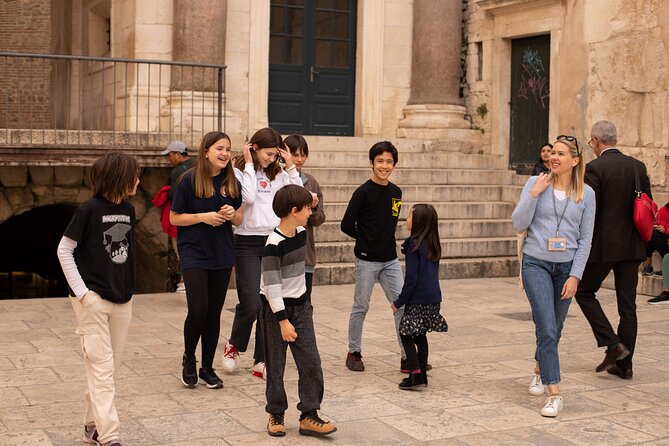
This is the kind of tour you book when you want your kids to learn without turning your vacation into a classroom. Split’s Diocletian’s Palace is massive, confusing, and full of details adults can appreciate. For kids, though, the palace can be overwhelming fast. That is why I like this setup: the guide turns the monuments into a sequence of do-this, find-that, count-this moments.
The format is also built for real family energy. Stops are short, and the route mixes big highlights (gates, squares, cathedral) with quick “hands-on” games (measuring a tiny street width, checking how sound behaves in an arcade corridor, counting columns). If you have ever watched a child’s attention clock tick down, you know how valuable that pacing is.
You should also know the tour includes a small group experience. Up to 6 people means it stays personal. If one kid needs a break, the whole tour does not grind to a halt.
More walking tours of Split:
- Split: Old Town and Diocletian Palace Walking Tour
★ 4.9 · 4,727 reviews - Walking Tour of Split and Diocletian’s Palace
★ 5.0 · 2,588 reviews - Krka Waterfalls tour with Trogir Walking tour and Krka panoramic boat cruise
★ 5.0 · 1,659 reviews
Price and time, and whether it feels like good value
The price is $358.87 per group (up to 6) for about 2 hours 30 minutes. On paper, that can look high if you compare it to a big group tour. But private family tours are priced for a reason: you are paying for a guide who can manage multiple ages at once, and you are not stuck waiting for the pace of strangers.
Also, the tour covers the biggest cost driver: entry is included for Diocletian’s Palace. Other key stops along the way are described as free entry, which helps stretch value across multiple sights rather than locking the day into one ticketed museum area.
If you are a couple with two kids, this is often a sweet spot. If you are a large family or traveling with friends who can join your group, splitting the cost among up to 6 people makes it feel more balanced.
Finally, the tour includes chocolate tasting. That sounds small, but during a timed walk through stone streets and palace corridors, it can prevent the usual meltdown from low sugar and low patience.
Getting started at Obala Hrvatskog narodnog preporoda 23
The tour begins at Obala Hrvatskog narodnog preporoda 23, 21000 Split and returns there at the end. That is practical. You get a clear meeting point, and you do not have to think about pickup logistics halfway through your day.
The meeting spot is also described as near public transportation, which matters if you are mixing the tour with other activities. With kids, it helps to keep your “anchor point” simple.
You will use a mobile ticket, and the tour is offered in English. The tour is private, so only your group participates. Service animals are allowed too, in case you need that.
One smart tip: arrive a few minutes early. With a private family tour, the best moments happen when everyone is ready to go, and you avoid losing time to last-second squeezing.
Diocletian’s Palace: the hour where kids actually engage
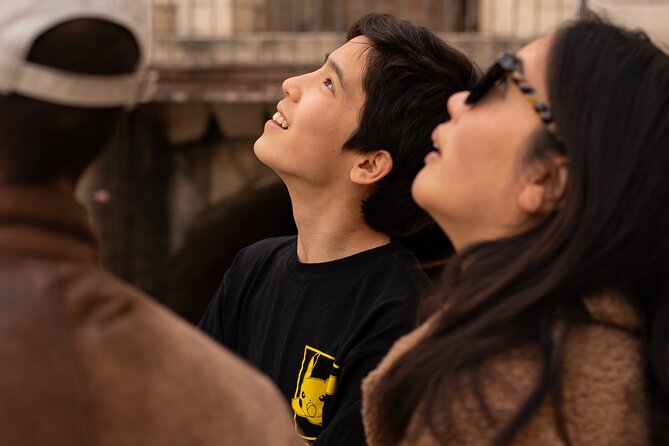
Stop 1 is the core: Diocletian’s Palace, about 1 hour, with the admission ticket included. This is where the guide’s job becomes creative. Instead of listing facts, the tour asks kids to actively participate, using tasks and a puzzle-style approach that helps them connect what they see to how people lived around 1700 years ago.
You can expect the guide to frame Diocletian not as a distant Roman figure, but as a real person with a household, rules, and daily routines. The palace is a whole city inside a city, so without structure kids can wander and adults can get frustrated trying to keep everyone together. Here, the structure is the entertainment.
There is also mention of treasure hunting for sweet specialties from Split. That is a clever technique for kids, because they remember an outcome more than a lecture. Adults also benefit, since it gives the tour a thematic thread: you are not just moving from stone to stone.
What might be a drawback? Inside the palace area, you will still be walking and looking at details. If your child is very sensitive to crowds or noise, plan for short breaks and lean into the game parts rather than trying to read every inscription.
A few more Split days worth comparing
- SPLIT-PRIVATE Walking Tour of Diocletian’s Palace & Old Town
★ 5.0 · 467 reviews - Private Krka Waterfalls tour with 30min Boat Cruse
★ 4.0 · 458 reviews - Split by Private Electric Rickshaw – Palace & Hidden Gems
★ 5.0 · 412 reviews - Private Blue cave, Mamma Mia and Hvar, 5 islands tour from Split
★ 5.0 · 387 reviews
Riva Harbor: a quick reset with sea air
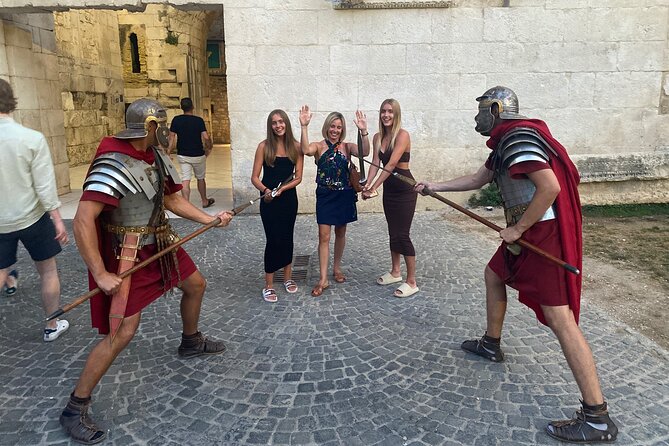
Stop 2, Riva Harbor, is about 10 minutes and free entry. This is a designed pause after the palace. You get the waterfront view, with sea air and a skyline vibe that helps kids decompress.
It is also a nice contrast. Roman stone, then palms and breeze. That rhythm matters on family tours, because a child’s brain processes the day like chapters in a story. One hour in the palace is not easy. A harbor view gives the group a reset without requiring a long stop.
Substructures: impressive cellars that feel like a secret world
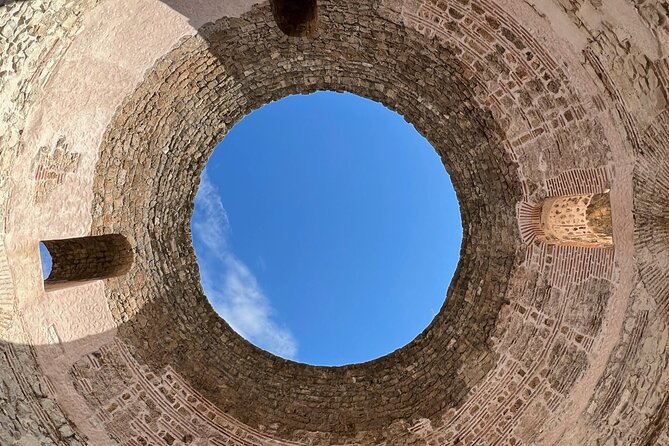
Stop 3 is the Diocletian Palace Substructures, about 10 minutes, free entry. The “cellars” here are described as impressive, and that makes sense. Underground spaces tend to feel like discovery zones for kids, especially when a guide sets the scene and points out what you can still make out of an ancient system.
This is one of those spots where kids may actually lean in, because it looks different from the sunlit street. If you are traveling with a kid who loves forts, tunnels, or anything “hidden,” this stop usually lands well.
Cathedral of Saint Domnius: the mausoleum story in five minutes
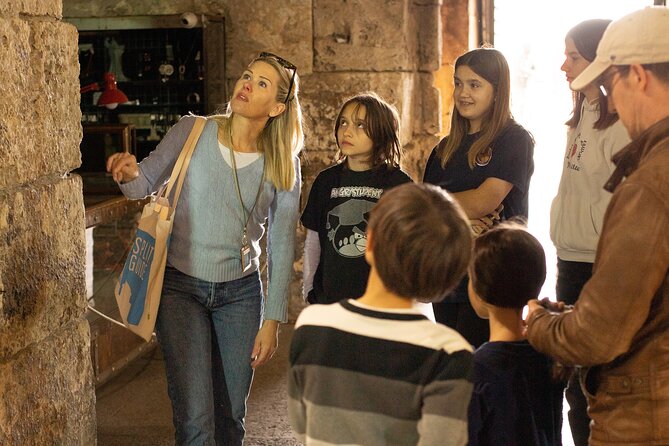
Stop 4 is Cathedral of Saint Domnius, about 5 minutes, free entry. The guide connects the site to Diocletian with a neat hook: there was once a coffin of Diocletian located in the center of the cathedral, and the cathedral still houses an important person, described as a famous saint.
For families, five minutes is the right length. It keeps the pacing intact while still giving you a sense of continuity from the palace to the religious heart of Split.
Peristyle: count columns and feel how power worked
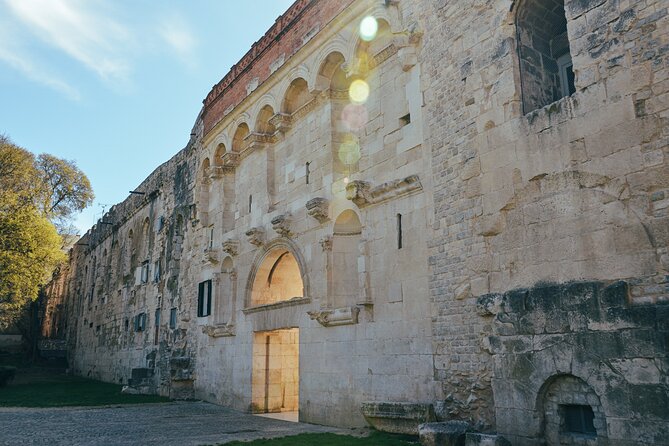
Stop 5 is The Peristyle of Diocletian’s Palace, about 10 minutes, and entry is not included. This stop is not just visual. It is interactive.
The Peristyle was the main square in the emperor’s time, functioning as the entry to Diocletian’s imperial apartment. The guide also talks about Diocletian’s self-presentation, including the idea that he positioned himself under the favor of Jupiter. Then, the tour invites kids to look around and count columns.
For adults, that column-counting is not math for math’s sake. It helps you notice scale and design. For kids, it turns a wide open space into a challenge, and it gives them a job instead of letting them get bored.
If you do not have time or budget for the optional admission at this point, do not panic. The time spent here is built into the walk, and your guide will still help you take the main sights in.
Eastern (Silver) Gate: double gate and the street logic
Stop 6 is Eastern (Silver) Gate, about 5 minutes, free entry. The guide frames it as an entrance from the east to the imperial palace, and mentions double gate details.
The payoff is how it connects to navigation. Kids are encouraged to look at the start of the first main street running east to west. That kind of explanation helps your brain map the palace layout in a way that photos alone cannot.
Even if you do not memorize dates, you will remember the street direction. That makes the rest of your time in Split feel more intuitive.
Triklinij: a story about eating in Diocletian’s time
Stop 7, Triklinij, is about 10 minutes, free entry. This is where the tour shifts from architecture to daily life.
Eating habits are explained in a way meant to trigger imagination: you are asked to picture feasts centuries ago in a place that still has the shape of how people gathered. For kids, food-based storytelling usually works because it feels personal and concrete.
Adults often find this is where the palace stops feeling like random ruins and starts feeling like someone’s home with routines.
Vestibulum: the acoustics moment kids love
Stop 8 is the Vestibulum of Diocletian’s Palace, about 5 minutes, free entry. The key feature is acoustics. The corridor is described as unusual and very acoustic, and the guide invites you to hear it in action.
This is one of those “science without the lecture” stops. If you have a kid who likes clapping, calling out, or testing sounds, this part can become a highlight even if the rest of the day feels heavy on stone.
Temple of Jupiter: ancient temple, present-day baptistery
Stop 9 is Temple of Jupiter, about 10 minutes, free entry. The tour explains that it used to be a temple and today it is a baptistery.
This stop is valuable because it shows how places in Split evolve. One structure can carry layers of meaning across centuries. Kids do not need big vocabulary to get the point, and a good guide will translate the transformation into an easy story: the same walls, new purpose.
Kraj Sv. Ivana 1: measure the smallest street
Stop 10 is Kraj Sv. Ivana 1, about 5 minutes, free entry. Here the tour turns geometry into a game: do you know how wide this smallest street in town is? Let’s measure it.
If you have ever taken a child to a narrow alley and watched them treat it like a secret passage, you will understand why this works. It also helps kids build a mental model of the old town layout. They will start to see the city as a grid of decisions, not random winding lanes.
Narodni Trg and the 24-digit clock moment
Stop 11 is Narodni Trg, about 5 minutes, free entry, with a view toward Pjaca. There is a unique clock with 24 digits. The guide asks what time it is on that clock.
This is a clever stop because it makes a landmark practical. Instead of just pointing at a building, the tour uses it as a mini challenge. Kids get a job, and adults get something specific to notice, which keeps boredom away.
Bajamontijeva ulica: army quarters, Italian symbols, and a fountain task
Stop 12 is Bajamontijeva ulica, about 5 minutes, free entry. The description is that it used to be a section for the army and later, with the arrival of Italians, many things changed in the palace area.
Then the guide adds tasks. Find the symbol of Italy, continue to the fountain, and there is another job connected to it. These “find it” and “go there” moments are exactly what make a family palace tour work. You are giving kids a path to follow, which reduces the constant question, What now?
This stop also quietly teaches you that Split did not freeze in ancient Roman time. It kept changing, and different eras left their marks.
The Golden Gate: double gate storytelling and why it mattered
Stop 13 is the Golden Gate, about 10 minutes, free entry. The tour focuses on construction details and the idea that the gate had a very important purpose. It also connects the story to the double gate concept within the palace.
For kids, gates are visual and dramatic. For adults, gates explain control and movement. They show where access was managed, and how power shaped the flow of people.
At the end of the walk, you are back at the start point, so it is easy to keep your day simple. If you want a treat after all that standing, you can. In one family tour led by Dana, the experience ended with gelato, which is a very logical closer after a long walk through palace corridors.
Snacks, water, and small practical tips that make the day easier
Included during the tour is snacks chocolate tasting. Soda is not included.
That matters for two reasons:
First, chocolate tasting helps, but it is not a substitute for hydration in warm weather.
Second, if your kids are sensitive to sugar swings, having water ready keeps things steadier.
Wear comfortable shoes. The tour is short per stop, but you still cover multiple areas on historic paving. If your child gets tired, lean into the interactive stops like measuring street width and the acoustics corridor. Those are built to take attention, and they can buy you time without forcing a break.
Who this tour is best for (and who should pick a different style)
This tour fits best if you want your kids to experience Split’s biggest Roman site in a structured way. It is especially good for ages 5 to 17, and the private group format helps when you have different ages with different stamina levels.
It is also a solid choice if you want an English-speaking guide who can keep the tour moving while still making sure the story makes sense.
If your family prefers long museum time, quiet reading, or lots of free roaming without prompts, you might find this tour too “guided game” and not enough “wander and browse.” In that case, you might pair a palace visit with more open time on your own.
Should you book this Split family private walking tour?
Book it if you want:
- a private, up-to-6 experience that respects family attention spans
- Diocletian’s Palace as the centerpiece with entry included
- a route that balances major sights with kid-focused tasks, plus a chocolate tasting payoff
Consider another option if:
- you know your group really struggles with outdoor walking in changing weather, since this experience depends on good conditions
- you want a less structured pace, with more time in one place rather than many short stops
If you are visiting Split with kids and you want them to remember something beyond photos, this tour is a practical bet. It turns the palace maze into a guided route your family can actually finish feeling proud, not exhausted.
Fresh options around Split
- Walking Tour Split★ 4.7 · 61 reviews
- Unique vintage Tomos moped tour Split – Back to the ’80s★ 4.8 · 17 reviews
- Essential Diocletian’s Palace Tour for First-Time Visitors★ 4.8 · 19 reviews
- Split: Trogir Open Top Bus Trip + Free Split Walking Tour★ 4.1 · 17 reviews
- Ranch 22 Podstrana, ” Horse riding 12 km from SPLIT “★ 4.5 · 79 reviews
- Zinfandel Wine Tasting & Storytelling with Dalmatian Food★ 5.0 · 20 reviews
- 1 st Waterbike Safari in the World★ 5.0 · 23 reviews
- Full-Day Quad and Wild Horses Safari in Livno from Split★ 5.0 · 12 reviews
Old Town Walking Tours, compared.
Walking Tour of Split and Diocletian’s Palace
Read our review →
Krka Waterfalls tour with Trogir Walking tour and Krka panoramic boat cruise
Read our review →
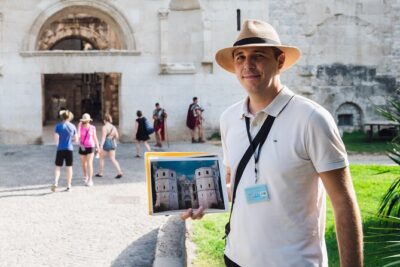
Walking Tour of Split with a ‘Magister’ of History
Read our review →
Plitvice Lakes: Guided Walking Tour with Train and Boat Ride
Read our review →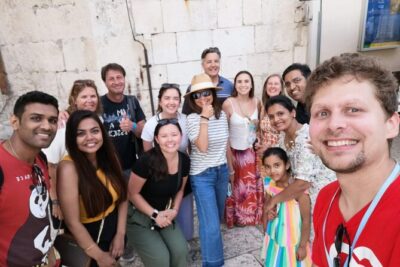
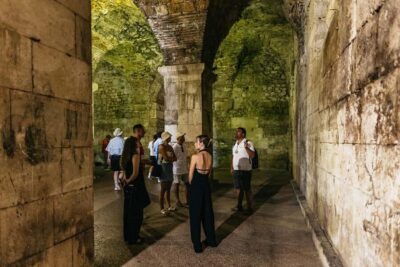
Diocletian Palace & Old Town Guided Walking Tour
Read our review →Browse the lists this tour appears in