
Reviewed · SPLIT
Experience Split With Local Professional Historian – Small Group
Split is one of those cities where the past still runs the show, and Diocletian’s Palace is the reason. This small-group history walk takes you through the main touchpoints while your guide uses a 3D reconstruction display book to turn confusing ruins into a real city people lived in.
The big payoff is clarity. You’ll walk away seeing how the Roman layout became a medieval town, and how modern Split flows right through it. The one catch: most of what you do is mostly exterior views of famous spots, so if you want lots of indoor time, you may need to plan separate visits.
Key highlights I think you’ll care about
- Max 12 people keeps the pace easy and questions possible.
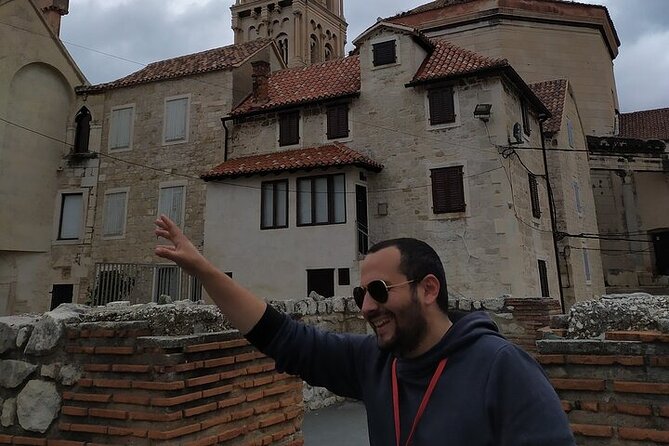
- Licensed local historian with a master’s degree in history leads the walk.
- 3D reconstructions and photos in a display book help you visualize what you are seeing.
- Photo guidance during the route so you can frame the palace and squares better.
- Ends on People’s Square (Pjaca), so you can keep exploring right after.
Entering Split at the Golden Gate, where the story starts
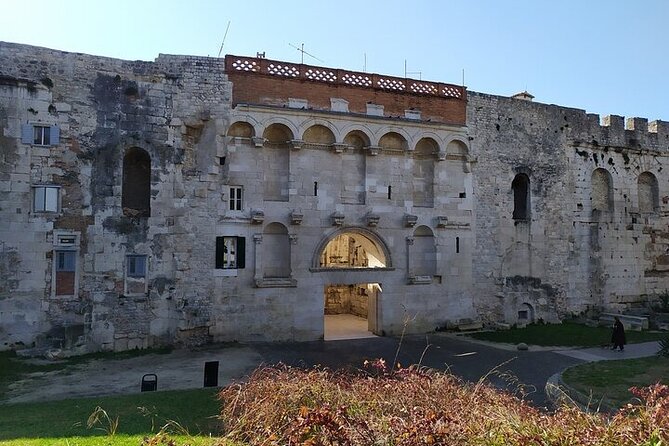
Most Split walks start at the obvious places. This one starts at the right hinge point: the Golden Gate, the northern gate into Diocletian’s Palace. Even though it is not made of gold, it is built of stone, and your guide uses it like a map. You stand at the entrance and immediately understand why the gate mattered, not just that it exists.
This stop is short, about 15 minutes, and that is a smart move. You are not stuck in a lecture before you see anything. You get orientation first, then you move on to the palace axis and the street-level landmarks that connect Roman power to everyday Split life today.
A practical detail: Golden Gate is across from one of the city’s most iconic photo stops, the Gregory of Nin area. So you can quickly connect what you hear in the first few minutes with what you see next, instead of treating the walk like a list.
More of Split worth an open tab:
- Split: Krka Waterfalls Trip with Boat Cruise and Swimming
★ 4.8 · 10,519 reviews - From Split: Krka Waterfalls, Food & Wine Tasting Tour
★ 5.0 · 9,326 reviews - Blue cave, Mamma Mia and Hvar, 5 islands speedboat tour
★ 5.0 · 7,150 reviews
Gregory of Nin and the statue that anchors the old town vibe
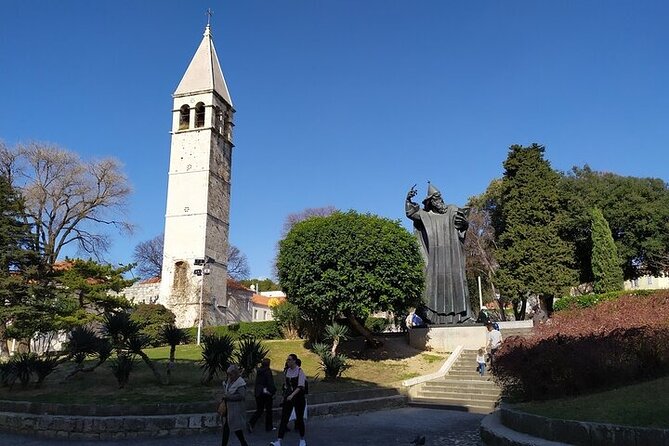
From the gate, you shift to Grgur Ninski, the famous statue of Gregory of Nin. Your guide keeps this from turning into a simple “who was he” stop. You get the human side: interesting facts about Gregory of Nin, why his monument is so prominent in Split, and what sculptor work went into shaping his image.
This is roughly a 10-minute stop. That matters because it keeps the emotional momentum. The statue is one of those places you instinctively want to photograph, and the timing means you’re not waiting for the highlight after you already got tired.
If you like history that connects to place, you will probably enjoy how the guide threads the story. You’re not only learning about a person, you’re also learning how Split chooses symbols and keeps them visible in public space.
Diocletian’s Palace walkthrough, with a 3D book that makes ruins make sense
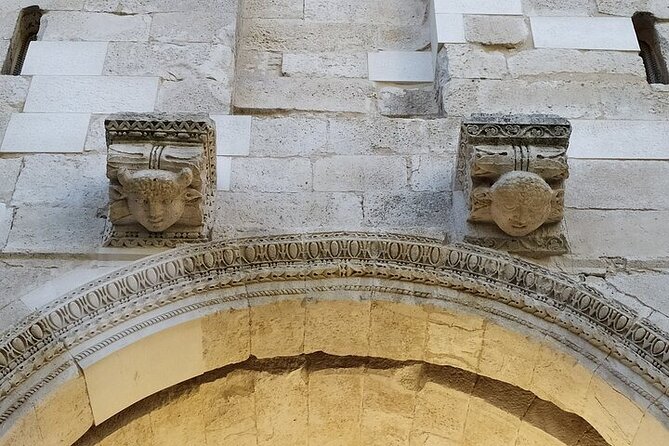
Now comes the heart of the tour: the palace itself. You spend time starting from the Golden Gate side and working through the most important parts, plus a few “hidden-gem” moments your guide points out.
Even better, you are not left to guess what you are looking at. The tour includes a display book with pictures and 3D reconstruction images, and that is huge for Diocletian’s Palace. From street level, a lot of stone can look like random geometry. With the reconstructions in front of you, the palace starts to behave like a planned environment: courts, transitions, religious spaces, and the machinery of power.
You also get the story of Diocletian himself, plus what happened after the Roman era, when the palace stopped being an imperial complex and started living as a medieval city. That “transition” angle is key. Split’s old town is not just Roman, it is Roman plus what came next. Your guide helps you see that layered reality instead of treating it as one clean timeline.
This section is about 20 minutes for the main palace features you’ll cover. Expect mostly outward viewpoints, plus a guided look at the layout and what key spots were used for.
The Peristyle, where power connects and divides people
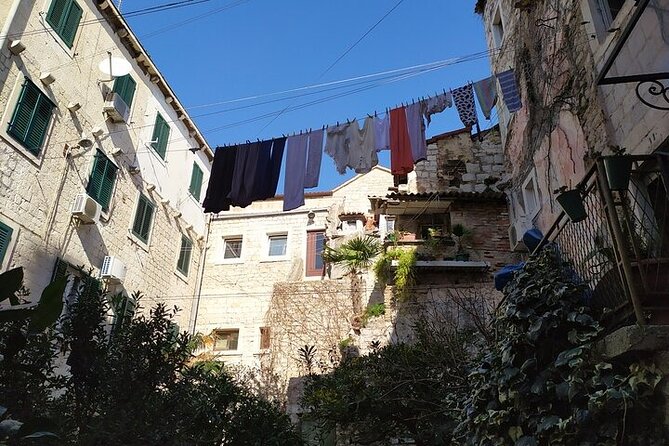
Standing in the center of the palace brings you to the Peristyle. This is one of the most important spaces in Diocletian’s Palace because it connects people and also creates separation, depending on rank and access. Your guide explains the function and importance in a way that makes the space feel logical, not intimidating.
From the Peristyle, you also get the best “look around and understand” effect. The guide’s job here is to help you read the palace like a living structure. What walls and corridors imply, why certain buildings face certain directions, and how the daily rhythm of the palace would have worked.
Then you move toward the central cellars area and the Triclinium viewpoint. The Triclinium stop is where eating habits enter the conversation. You learn about Roman emperor dining room organization, which might sound niche, but it actually helps you understand how status showed up in everyday rituals.
Also note the tour includes time for explaining how expansion of Christianity changed the use and meaning of spaces. That is part of what keeps Diocletian’s Palace from feeling like a sealed museum case. It is a site that kept changing roles as beliefs changed.
Same stretch of the Dalmatian coast, a different kind of day:
- From Split: Krka Waterfalls, Food & Wine Tasting Tour
★ 4.9 · 6,598 reviews - Split/Trogir: Blue Cave, Mamma Mia, Hvar and 5 Island Tour
★ 4.6 · 6,320 reviews - Blue Lagoon & 3 Islands Cruise with Lunch from Split
★ 4.5 · 5,756 reviews - Split: Old Town and Diocletian Palace Walking Tour
★ 4.9 · 4,727 reviews
Jupiter’s Temple and St Domnius, the religion thread you can actually follow
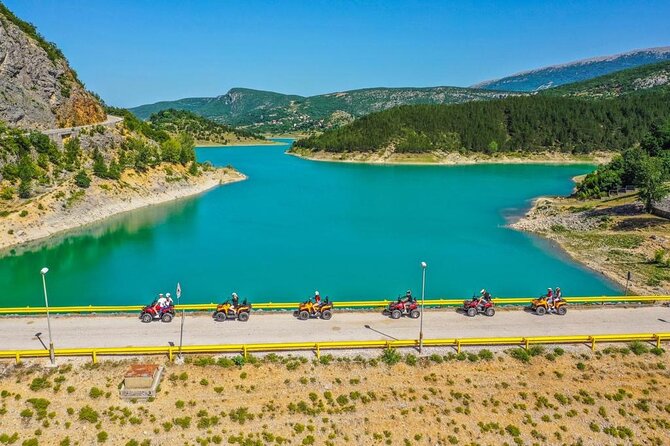
Next you see Temple of Jupiter from outside. Your guide uses this to explain the importance of religion in Roman Empire life, especially how temples to honor gods were a normal part of Roman residences. This stop is around 10 minutes, but it gives you context that makes the rest of the route easier.
After that comes the Cathedral of Saint Domnius from outside. This is another 10-minute orientation moment. You are not going inside during this tour, but you do get guidance on what parts to notice and what to watch for if you visit the cathedral later on your own.
This religion sequence matters because it shows you how the palace evolved. Roman pagan worship is one phase. Later Christian use is another. When your guide points out significant parts and gives you a heads-up about the interior, it turns a quick stop into a useful preview for your own follow-up.
VestibuLum into the private world, then the sea-facing pulse of Riva
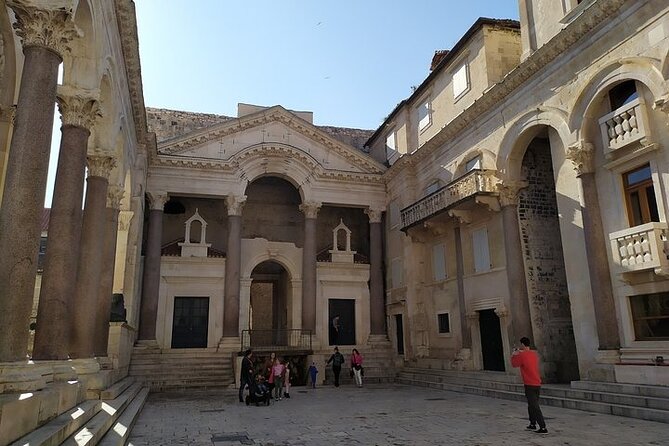
One of the more interesting stops is the Vestibulum of Diocletian’s Palace, the pre-entrance connected to the emperor’s private chambers. It’s about 10 minutes, and while you are viewing it from outside, the point is to understand what “private” meant in an imperial setting. The guide explains how it looked and what its function was, which helps you grasp that access was controlled, even before you reach the main rooms.
Then you shift gears from stone power to street life: Riva Harbor. This is where Split’s energy feels modern and casual. The tour stops there for about 5 minutes, and your guide explains how Riva was built across centuries and why it became the city’s central promenade.
If you have never been here, Riva Harbor is the kind of place that makes you stop and look around even without a guide. So the short stop works well. You get context, then you can keep soaking in the atmosphere after the tour ends.
Fruit Square and Pjaca, where the local city story stays visible
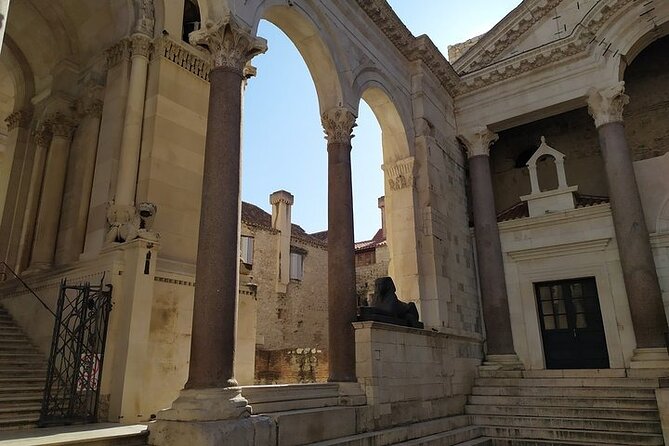
From Riva you move to Fruit Square, also called Trg Brace Radic. This is a smaller, charming pause, about 10 minutes. Your guide explains why it is called Fruit Square and points out the monument in the center, plus the surrounding important sights.
Then you finish at Pjaca, also known as People’s Square. This is the classic “everything happens here” kind of place. Your guide explains why it has functioned as a center of city life from medieval times to today, and talks through the story behind the square and key buildings around it.
This last stretch is great because it closes the loop. You start with a fortified imperial gate. You end in a public square where people gather, trade, talk, and pass time. The tour doesn’t just teach you dates. It teaches you how space shapes daily life.
Photo help and conversation style, what to expect from the guide
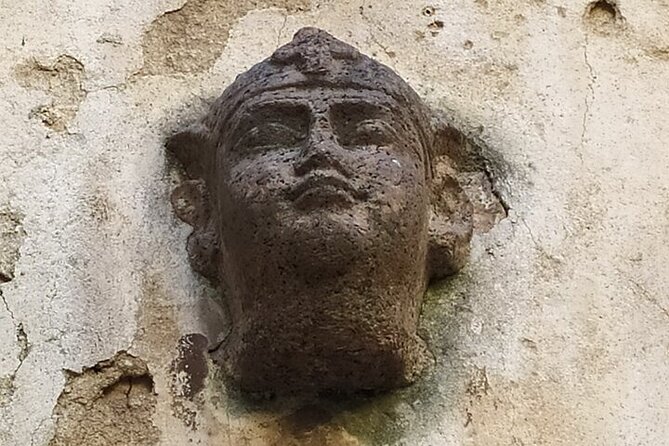
One of the most consistently praised parts of this tour is the way the guide leads it like a teacher. He is described as a history professor, and you can feel it in the pacing. The talk is not only facts. It is explanations you can follow, plus frequent opportunities to ask questions.
You will also get practical photo help. That means your guide pays attention to angles, timing, and framing at the palace and key squares. It is not a “stand here and take a picture” script. It is guidance that helps you take photos that actually show what you learned.
Some reviews mention extra interaction like trivia questions, and that fits the overall style. It keeps the tour moving and turns “I’m listening” into “I’m participating,” which is especially useful if you are traveling with kids or teens.
How the 2-hour format really works, and what it leaves out
This is a short, efficient tour, about 2 hours on paper, and it can run closer to 2.5 hours if questions come up. That timing is a big value point. You get a fast overview of Diocletian’s Palace, plus the surrounding Split structure, without losing half a day to walking.
What it leaves out is also important. Most of the major stops are outside viewpoints, including Jupiter’s Temple and St Domnius. The tour also includes a quick orientation to cathedral interior hints, but it does not replace actually going in.
So I’d treat this as your “get your bearings fast” tour. After it ends at Pjaca, you are set up to choose what to do next: cathedral time, deeper palace exploration on your own, or a slow coffee stop around the squares.
Price and value: what $38.62 buys you in Split
At $38.62 per person for about 2 hours, you are paying for three things more than you are paying for tickets.
First, you are paying for a licensed local guide with a master’s degree in history. Second, you are paying for the display book with 3D reconstructions, which helps you understand what you see instead of just passing monuments. Third, the tour route includes a set of stops marked as free entry, so you are not stacking extra costs just to participate.
You are also buying time efficiency. For a city like Split, where Diocletian’s Palace can feel overwhelming, a guided overview is often the difference between scattered photos and real comprehension. The small group size, capped at 12, supports that value by keeping the walk interactive and not crowded.
If you are booking in advance, note that this tour is commonly booked about 62 days ahead on average. That is a sign that popular weeks can fill up, so earlier planning is smart.
Getting the most from your walk: small habits that pay off
To make this tour land, show up ready to ask questions. The format is designed for questions, and it can stretch by a bit when people engage, which is usually a good sign.
Also, bring your “photo mode” thinking. Since the guide can help you with framing, pause when asked. If you run ahead constantly, you lose the best viewpoints and context.
One more practical tip: wear shoes that handle uneven old-town surfaces. You will cover palace streets and steps around gates and squares, and comfortable footing lets you focus on the story instead of adjusting your pace.
Should you book this Split small-group palace history tour?
Yes, if you want a high-impact overview of Split’s core without getting lost in Roman terms. This is especially a good fit for first-timers, history-minded travelers, and anyone who likes explanations that connect the palace to modern life.
Skip it or plan extra time if your main goal is indoor access and long museum-style visits. This walk is mostly about seeing the key spaces, understanding what they were, and then using that knowledge to explore more on your own.
If your schedule is tight, or you want one smart guided start before you wander the rest of Split, this one is an easy recommendation.
FAQ
How long is the Split experience?
It runs for about 2 hours. It can run a bit longer depending on how many questions come up.
Is the tour offered in English?
Yes, it is offered in English.
What is the group size limit?
The group is capped at a maximum of 12 travelers, which keeps the experience small.
Where do we meet and where does the tour end?
You meet at Golden Gate, Dioklecijanova 7, 21000 Split. The tour ends at People’s Square, Pjaca.
What is included besides the walking?
You get a local licensed guide with a master’s degree in history, plus a display book with pictures and 3D reconstruction images.
Are admission tickets included for the sights?
The tour does not include paid admission tickets. The stops on this route are marked as free for participants.
Will I receive a mobile ticket?
Yes, the tour includes a mobile ticket.
Are service animals allowed?
Yes, service animals are allowed.
Does the tour depend on weather?
Yes, it requires good weather. If it is canceled due to poor weather, you will be offered a different date or a full refund.
What is the cancellation window for a full refund?
You can cancel up to 24 hours in advance for a full refund. If you cancel less than 24 hours before the start time, the amount paid will not be refunded.
Fresh options around Split
- Walking Tour Split★ 4.7 · 61 reviews
- Unique vintage Tomos moped tour Split – Back to the ’80s★ 4.8 · 17 reviews
- Essential Diocletian’s Palace Tour for First-Time Visitors★ 4.8 · 19 reviews
- Split: Trogir Open Top Bus Trip + Free Split Walking Tour★ 4.1 · 17 reviews
- Ranch 22 Podstrana, ” Horse riding 12 km from SPLIT “★ 4.5 · 79 reviews
- Zinfandel Wine Tasting & Storytelling with Dalmatian Food★ 5.0 · 20 reviews
- Full-Day Quad and Wild Horses Safari in Livno from Split★ 5.0 · 12 reviews
- Best Private Split Walking Tour, Panoramic View and Port Pickup★ 5.0 · 29 reviews