
Reviewed · KLIS FORTRESS & SALONA TOURS
Salona & Amphitheater – Private guided tour – Admission incl.
A walk through Roman Salona, finishing at the amphitheater, is interesting because you can see layers of history in a very human scale. I like the private, paced guidance with an English-speaking guide named Ivan. I also like that the route moves from the Roman city world into early Christian stories tied to martyrs and cemeteries. One drawback to plan for: this is mostly outdoors, so comfortable shoes and good weather matter.
The tour runs about 2 hours 30 minutes and loops back to the start at Salona’s main entrance on Ul. don Frane Bulića 58 in Solin. You get a mobile ticket, and it’s just your group, not a shared bus-style experience. Service animals are allowed, and the tour is set up so most people can participate.
Admission is listed as included, but one part of the visit notes an open-air museum entrance fee of about 10 euros for adults, so I’d treat that as something to confirm at booking. The payoff is that you walk through a site that once held roughly 60,000 people, then was later destroyed, and then kept telling its story through ruins.
Key things you should know before you go
- Private guide, English language, and a steady walk so the sites make sense instead of feeling like random stones
- Ancient Salona’s big scale including the Roman metropolis size and later destruction that reshaped everything
- Manastirine and St. Dominius linking Roman burial ground to Christian memory
- Don Frane Bulić’s Tusculum showing how archaeology in Split is tied to local figures and faith
- Porta Caesarea chariot ruts where the Roman city still leaves marks you can actually spot
- Amphitheatre Salona as the climax with its surprisingly preserved structure, even after stone was taken by Venetians
Ancient Salona start: the city that kept getting rewritten
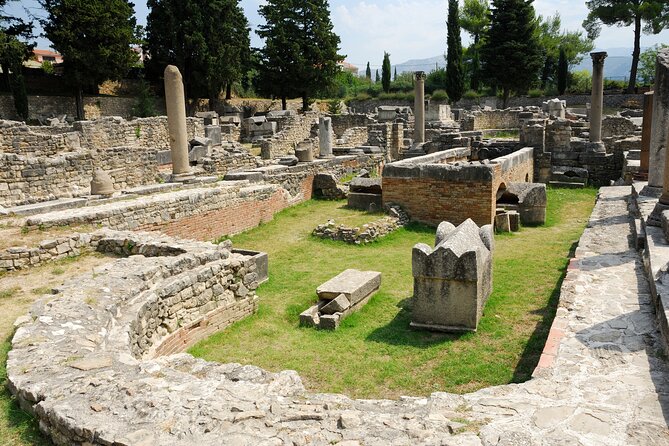
Your experience begins at the Salona main entrance in Solin, and right away the guide frames what you’re looking at. Salona was a Roman metropolis with about 60,000 inhabitants. Then the city was destroyed in the 6th century by the Avars, an equestrian people. That wipeout matters because it explains why what you see now is not a neat, continuous monument. It is a set of traces, rebuilt eras, and survival.
You spend roughly 15 minutes in this first orientation phase on foot, with general information given at the entrance. This is also where the tour notes an open-air museum entrance fee of about 10 euros for adults, with that ticket not clearly included in the stop description. Practically, you should plan for the possibility of a small additional cost tied to the museum area, even if your overall tour price says admission is included. (It only takes a quick check when you book.)
What I like about starting here is simple: you get the “why” before you get the “where.” Even if you’ve seen Roman ruins before, the scale of Salona sets expectations. You’re not touring a single courtyard. You’re walking the edges of a major city.
More Klis Fortress and Salona history:
- Split: Klis Sunset Sightseeing Bus Tour
★ 4.4 · 494 reviews - Split: Klis Fortress GOT and Olive Museum Entry Tickets
★ 4.6 · 283 reviews - Split: Historical Tour of Salona, Klis Fortress and Trogir
★ 4.1 · 108 reviews
Manastirine: when a necropolis becomes a Christian cemetery
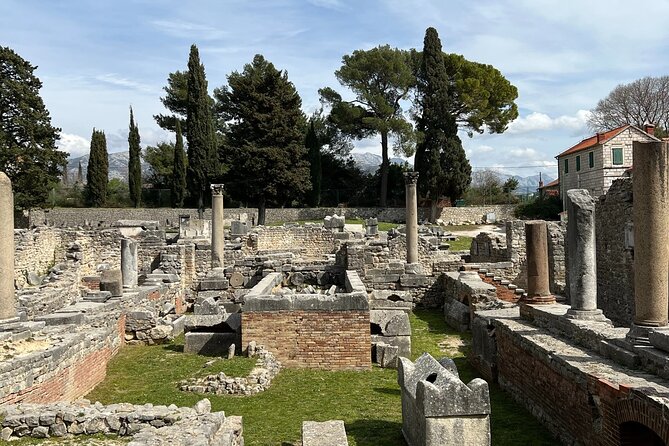
Next comes Manastirine, a site that shows Roman history and Christian history without needing a big speech. In Roman times, this area served as a necropolis. Later, it became a Christian cemetery, and that shift is the point.
The guide connects this place to the martyr and city patron of Split, St. Dominius. That name gives the stop a pulse. You’re not just looking at an old burial ground. You’re standing on ground that changed religious meaning over time, even when the physical setting stayed the same.
This stop is only around 15 minutes, so it works best as a “chapter break.” You look, you absorb the transition from Roman funerary use to Christian burial memory, and then you move on before you start thinking too hard. The best part is that the tour doesn’t treat these places as isolated stops. It keeps threading the story forward.
One consideration: cemeteries and martyr-linked sites can feel emotionally heavy for some people. If you’re the kind of visitor who prefers only big, dramatic ruins, you may find this stretch more reflective than spectacular. Still, it’s exactly what makes this tour different from a generic amphitheater visit.
Tusculum and the human side of archaeology
Then you reach Tusculum, a building tied to a specific person: Don Frane Bulić. He was a famous clergyman and archaeologist from Split, and he built Tusculum as an office and meeting place. Some rooms can be visited, so it’s not just viewing exterior walls. It gives you a small, concrete sense of how archaeology was studied and organized here.
Spend about 15 minutes at Tusculum. That short time frame is ideal because it gives you the “how” of research without dragging the pace. You get a reminder that these ruins did not become “museum material” by accident. People in Split worked to uncover, interpret, and preserve what came before.
I also like how this stop adds a third layer beyond Roman and Christian. It’s a modern layer, meaning the city’s story was rediscovered and re-storied by local figures. That makes the tour feel less like distant history and more like a living connection.
Bishop’s palace and the foundations of two cathedrals
After Tusculum, the route moves to the bishop’s palace area (Biskupska palača, or Palatium episcopi). This stop is only about 15 minutes, and today what you mainly see are foundation walls. But the foundations matter because they’re tied to a major change: the time when Christians were allowed to practice their religion freely.
The site includes remains of two cathedrals from that era. Even though so little stands at full height, you can still feel the scale through what’s left. Foundations are honest. They don’t try to impersonate something grander than it is. Instead, they show you the footprint of belief and authority in a city that had already been through destruction and transformation.
This stop may feel quiet compared to the amphitheater. If you’re craving the most dramatic visuals, you might wish for more. But as a viewer, you’ll likely appreciate it for what it is: a lesson in how power and faith leave outlines, not always full structures.
A few more Split days worth comparing
- SPLIT-PRIVATE Walking Tour of Diocletian’s Palace & Old Town
★ 5.0 · 467 reviews - Private Krka Waterfalls tour with 30min Boat Cruse
★ 4.0 · 458 reviews - Split by Private Electric Rickshaw – Palace & Hidden Gems
★ 5.0 · 412 reviews - Private Blue cave, Mamma Mia and Hvar, 5 islands tour from Split
★ 5.0 · 387 reviews
The large urban spa: Roman baths as social life
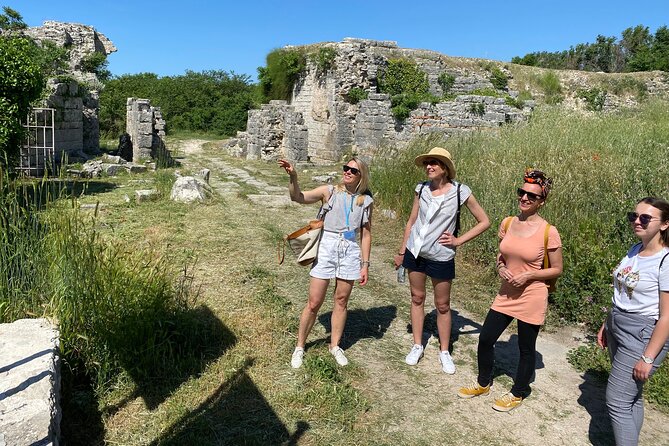
Next up, you see the large urban spa, a Roman bath complex. The tour positions it as a center of social and cultural life in Roman times, used for several hundred years. That is an important nuance. Many ruins feel like backdrops, but baths were active places. People gathered. People talked. People lived their daily routine.
This stop is around 10 minutes, so you won’t be stuck for long. Instead, you get a quick but meaningful snapshot of what “Roman daily life” could look like. It also helps balance the heavier martyr and cemetery stops. You go from death memory to a place where life and conversation were part of the routine.
If you’re the kind of traveler who likes ruins with a daily-life angle, this is one of the stops that keeps the tour from becoming too solemn.
Pet mostova and the five bridges of an industrial edge
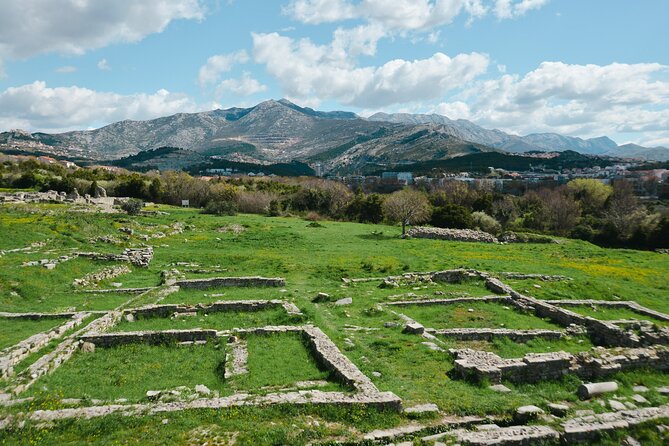
Pet mostova is next, about 10 minutes. The name points to the five bridges, and the tour connects these bridges to a kind of industrial area outside the old city center. That detail matters because it prevents you from picturing Salona as only temples and theaters.
Here you start seeing the city’s working side, the area where infrastructure served movement and function. You get a more complete picture of how a metropolis operates: not just ceremonial spaces, but systems that supported labor and transport.
This is not a stop built for dramatic photos, unless you’re photographing patterns and structure. But it’s valuable for your understanding. If you want to leave with a sense of how Salona actually ran, not just how it was celebrated, Pet mostova helps.
Porta Caesarea: the capital gate and visible chariot ruts
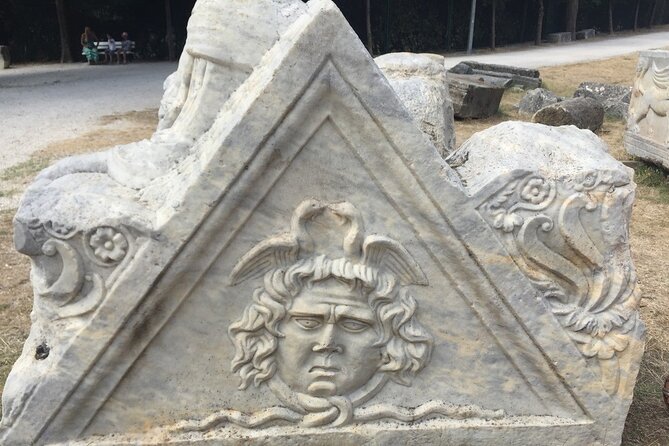
Now you reach Porta Caesarea, the capital gate in Roman times. This stop is around 10 minutes, and it has one of the most concrete, wow-you-can-see-it moments on the route: ruts of old Roman chariots still visible today.
That’s the kind of detail that turns ruins into something physical. You’re not only hearing that chariots rolled through. You can spot the grooves connected to that movement. It’s the rare case where the past leaves a readable signature.
If you like “micro evidence” like this, you’ll enjoy how quickly the guide makes the gate feel real. Even in a short time window, you get a tangible connection between Roman traffic and the surviving wear in stone and ground.
Hram: forum remnants, a temple, and an ancient Roman theater
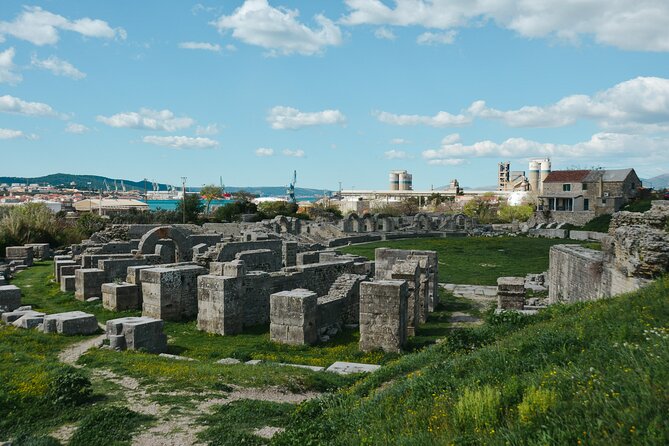
The next stop, Hram, takes you into the oldest part of the city. You’ll see remains of the forum, a temple, and an ancient Roman theater. At about 10 minutes, it’s a highlight in the sense that it covers a lot of important civic pieces quickly.
This is where the tour starts to line up the big themes. A forum is civic life and public decision-making. A temple relates to religious practice. A theater signals culture and entertainment. Together, they help you imagine Salona’s “center of gravity” even if the buildings themselves are mostly fragments.
The caution here is pacing. In a single short stop, it’s easy for a visitor to miss details if you’re rushing. Slow down, look from one feature to another, and let the guide connect the dots. That’s how this part becomes memorable rather than just a checklist.
Cemetery of the 16 Sarcophagi and the road toward the amphitheater
Your next steps turn more directly toward the amphitheater approach. At Ul. don Frane Bulića 91, you visit the cemetery of the 16 sarcophagi. This necropolis sits next to the road leading to the amphitheater, and that location tells you a lot about Roman planning.
Roman cemeteries were built outside the city walls, and this one follows the pattern. It also places the dead alongside the path of the living. When people walked toward the amphitheater for events, this road held reminders of mortality.
This stop is about 10 minutes. It’s likely to land best if you’re already paying attention to the tour’s rhythm of “city life, then ritual, then death, then spectacle.” The guide’s storytelling helps it feel linked instead of random.
Kapljuc: martyrs tied to the amphitheater’s early 4th century persecution
Then comes Kapljuc, another basilica and necropolis. Here, the tour connects five martyrs who died in the amphitheater at the beginning of the 4th century during the persecution of Christians by Diocletian.
This is a heavy historical thread, and the benefit of having a guide is that you’re not left guessing what the place means. It’s about understanding why certain burial sites matter when they are connected to specific episodes of persecution.
Again, about 10 minutes. You’ll see basilica and necropolis remnants, but the real value is the context linking the story of Salona’s amphitheater to later Christian memory. If you’re tired, this is not the best moment to mentally multitask. Give it your attention for a few minutes and you’ll feel the logic of the route.
Amphitheatre Salona: the climax, preserved despite Venetian stone-hunting
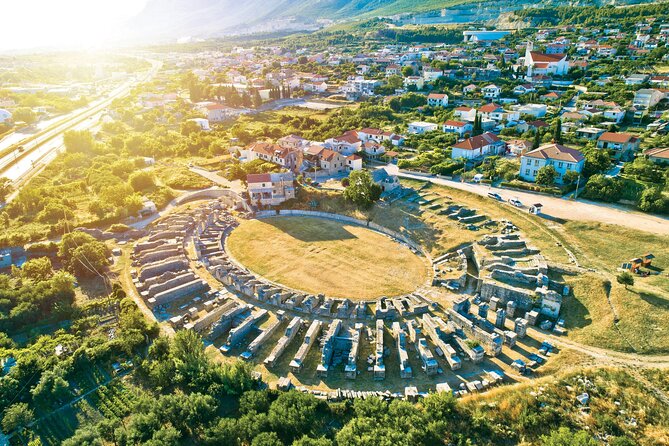
Finally, you reach the amphitheater, the highlight of the tour, with about 30 minutes there. The amphitheater is relatively well preserved, even though the Venetians removed most of the stones to build churches in Venice.
That detail is almost funny in a grim way. You’re looking at a major structure that still stands because it survived a long period of reuse and scavenging. Venetians did what powerful cities often did, they used valuable material from older sites. The amphitheater’s endurance gives you a real sense of why Roman engineering earned its reputation.
Spend time here rather than rushing. Look around and let the guide connect the amphitheater to what you’ve already seen along the route, especially the martyr-linked story. By the time you arrive, you’ve walked the city’s civic and religious layers and the funerary landscape leading toward this stage.
If you’re only interested in one stop, make it this one. This is where Salona stops feeling like a lesson and becomes a place where you can picture events.
Price and timing: is $203.50 worth a private 2.5-hour circuit?
The price is $203.50 per person for a private guided tour of about 2 hours 30 minutes, offered in English. It’s not the cheapest way to see ruins, but private guiding is paying for three things: clarity, pacing, and context.
First, context is the big deal here. Salona’s story runs across Roman civic life, Roman burial practices, and early Christian memory tied to named figures and specific historical episodes. Without guidance, you can walk among the remains and still miss why one site sits where it does. With a guide like Ivan, the stops connect into a route, not separate trivia.
Second, pacing matters for a site like this. Some stops are only 10 or 15 minutes, then you get a longer 30 minutes at the amphitheater. That rhythm keeps you moving but gives the grand finish enough time.
Third, admission is described as included, and many of the other stops are free to enter on their own. The only part that looks like it may involve an additional adult fee is the open-air museum connected with Ancient Salona, listed at around 10 euros. Because that’s close to your budget decision, I’d treat it as a quick confirmation item.
A practical note: this tour is booked on average 84 days in advance, so it’s smart to plan ahead if you want a specific date. If your schedule is tight in Split and Solin, earlier booking usually helps you land the time you want.
Also, this experience requires good weather. You’re walking outside, and the tour is built around a set route. If it rains hard, you might lose comfort even if the ruins remain open.
Should you book this Salona and amphitheater tour?
Book it if you want more than photos. This tour is built for people who like stories tied to place, especially when Roman life and early Christian history overlap in the same walk. The private setup also helps if you want your questions answered on the spot rather than guessing on your own.
Skip it or consider a simpler plan if you mainly want one dramatic landmark and you’re comfortable mapping history yourself with minimal guidance. This route works best when you care about how each ruin supports the next chapter.
FAQ
FAQ
Is admission included, and do I need tickets for the sites?
The tour is listed as having admission included. That said, the Ancient Salona open-air museum entrance is shown with an adult fee of about 10 euros and notes that the admission ticket is not included for that specific stop. It’s a good idea to confirm exactly what is covered when you book.
How long is the guided tour?
It runs for about 2 hours 30 minutes.
Is this a private tour or will I share it with others?
It is a private tour/activity, so only your group participates.
What language is the tour offered in?
The tour is offered in English.
Where do we meet for the tour?
You meet at the Salona main entrance, Ul. don Frane Bulića 58, 21210 Solin, Croatia. The tour ends back at the meeting point.
What happens if the weather is bad or I need to cancel?
The experience requires good weather. If it is canceled due to poor weather, you will be offered a different date or a full refund. You can cancel for a full refund up to 24 hours in advance.
Fresh options around Split
- Walking Tour Split★ 4.7 · 61 reviews
- Unique vintage Tomos moped tour Split – Back to the ’80s★ 4.8 · 17 reviews
- Essential Diocletian’s Palace Tour for First-Time Visitors★ 4.8 · 19 reviews
- Split: Trogir Open Top Bus Trip + Free Split Walking Tour★ 4.1 · 17 reviews
- Ranch 22 Podstrana, ” Horse riding 12 km from SPLIT “★ 4.5 · 79 reviews
- Zinfandel Wine Tasting & Storytelling with Dalmatian Food★ 5.0 · 20 reviews
- 1 st Waterbike Safari in the World★ 5.0 · 23 reviews
- Full-Day Quad and Wild Horses Safari in Livno from Split★ 5.0 · 12 reviews
Klis Fortress & Salona Tours, compared.
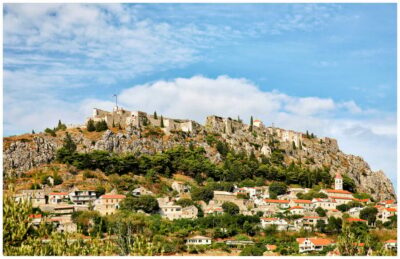
Klis Fortress GOT and Olive Museum Entry Tickets
Read our review →
Historical Tour of Salona, Klis Fortress and Trogir
Read our review →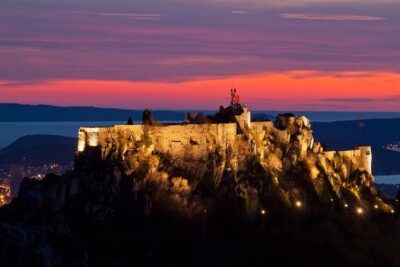

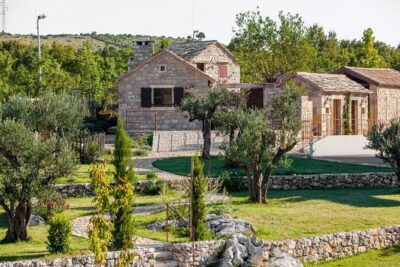
Olive museum Klis with educational olive oil tasting
Read our review →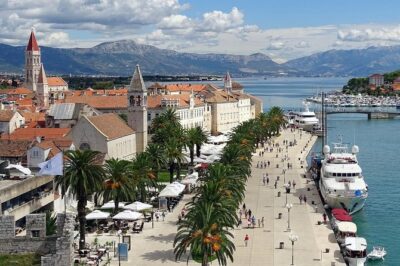
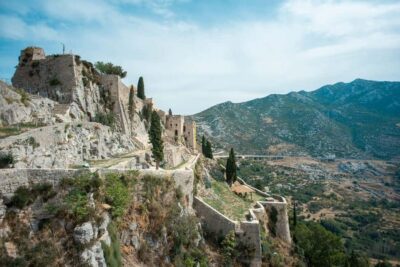
Private tour to Klis Fortress and Vranjača cave
Read our review →Browse the lists this tour appears in