
Reviewed · HISTORICAL TOURS
Private History tour – small group
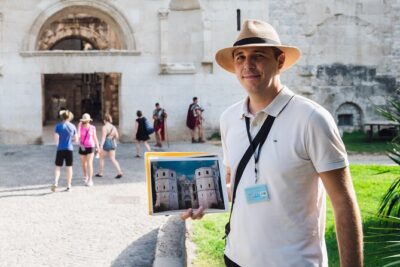
Split can feel like a puzzle at first, with stone everywhere and streets that twist toward the sea. This tour is interesting because it turns that puzzle into a clear story, step by step, without rushing you. I especially like the focus from guide Ivan Fistanic, who has a Master’s degree in History.
You also get the major landmarks of Diocletian’s Palace explained in a way that makes the city feel logical, not random.
One thing to consider: it is mostly an outdoor walk, and it is only about 1.5 to 2 hours. Also, a couple of stops, like the cathedral and the Jupiter Temple, are viewed and explained but you will need tickets for those, since entry is not included.
Key things to look for
- A history-minded guide who explains what you are seeing, not just what it used to be
- Diocletian’s Palace in the right order, from the Golden Gate to the Peristyle
- Views you can actually use, like spotting how the Palace faces the waterfront
- Christian-era changes explained, including how older spaces were repurposed
- Small-group pacing, with room for questions (this is a private tour for your group)
Why Diocletian’s Palace is the real map of Split
If you want to understand Split quickly, you do not start with beaches or nightlife. You start with Diocletian’s Palace, because it is the backbone of the old town. Even if you have visited other Roman sites before, Split hits differently because the buildings stayed in use and kept changing as centuries passed.
This tour makes that shift from Roman to later eras feel tangible. You walk among the stones, then you connect them to the story your guide is telling. The result is that you leave with a mental map, not just photos.
The guide’s background matters here. With Ivan Fistanic leading, the explanations stay concrete. You hear why entrances were placed where they were, how public and private zones worked, and what later residents did with what they inherited. It is a history walk that does not require you to be a scholar.
A few more Split days worth comparing
- Walking Tour of Split with a ‘Magister’ of History
★ 5.0 · 1,122 reviews - Split Walking Tour with Professor of History
★ 5.0 · 926 reviews - Split: History and Heritage Walking Tour
★ 4.9 · 650 reviews
Meeting in central Split, then walking with a small group
The tour starts at Ul. kralja Tomislava 15, and it ends back at the same spot. That matters more than it sounds. If your base is central, you lose less time crossing town and more time learning while the sights are still in front of you.
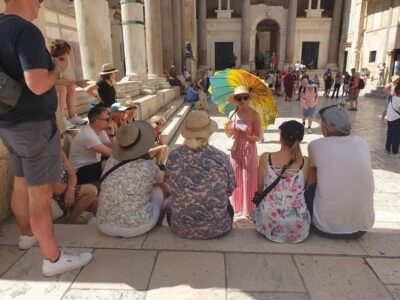
This is a private tour for your group, capped at up to 10 people. That small size changes the feel. It is not a loud herd moving on autopilot. It is easier to ask a question when something catches your eye, whether that is a detail on a doorway or a reason a square looks the way it does.
You also get a mobile ticket, which is handy if you like to travel light. And since the meeting point is near public transportation, it is easy to plug into your day in Split without stress.
Golden Gate and the Roman entry point that you can actually picture
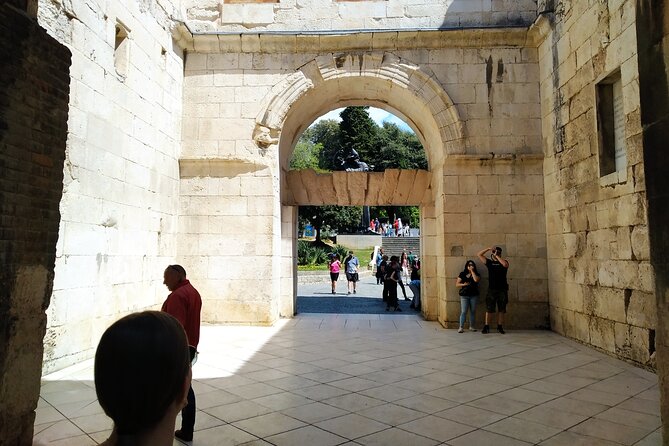
Your first big anchor is the Golden Gate, one of the main Roman gates through Diocletian’s Palace. It was the entrance on the road to the north, heading toward Salona, the Roman provincial capital and the birthplace of Diocletian.
Standing here, you can see how Split was once built like a controlled system. Gates were not decoration. They shaped movement, arrivals, and power. It also helps that Golden Gate sits opposite the Gregory of Nin area, so you quickly connect two Split landmarks that can otherwise feel unrelated when you first arrive.
Even if you only take a few minutes at this stop, you are learning a framework. From here, you understand that you are not wandering an old city at random. You are moving through a Roman plan that still influences the streets today.
Inside Diocletian’s Palace: cellars, Peristyle, and why the center mattered
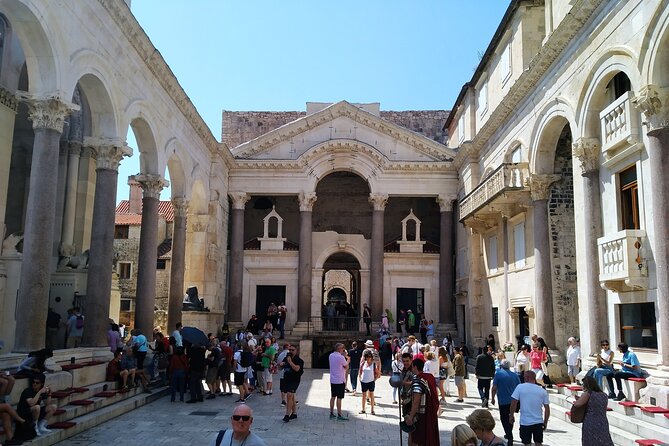
Next, you head into the palace zone from the waterfront area. You enter the central part of the cellars of Diocletian’s Palace, where the guide explains how these spaces were used through history. Then the tour opens out into the Peristyle, the open space of the imperial square.
This is where the tour really shows you why the palace design is so effective. The Peristyle is framed by monumental arcades and oriented toward the imperial loggia. In plain terms, it is a stage. When you stand in that square, you can imagine how authority and ceremony worked because the architecture still points your gaze and creates a sense of order.
The best part is how you are not stuck in a single era. Your guide talks about changes as Christianity expanded, and how building transitions affected daily life. You start noticing that history is not a clean line. It is layers.
Same stretch of the Dalmatian coast, a different kind of day:
- Split: Krka Waterfalls Trip with Boat Cruise and Swimming
★ 4.8 · 10,519 reviews - From Split: Krka Waterfalls, Food & Wine Tasting Tour
★ 5.0 · 9,326 reviews - Blue cave, Mamma Mia and Hvar, 5 islands speedboat tour
★ 5.0 · 7,150 reviews - From Split: Krka Waterfalls, Food & Wine Tasting Tour
★ 4.9 · 6,598 reviews
Cathedral of St. Domnius: a Roman structure still in use
From the Peristyle, the Cathedral of St. Domnius is hard to miss. The tour focuses on what you can see outside and around it. You do not enter the cathedral, but your guide points out the significant parts and explains the story behind them.
This stop is valuable because it shows how survival works in architecture. The cathedral is described as one of the best preserved Roman structures in Split and it is still in use today. Even without stepping inside, you get the message: Roman buildings were not always abandoned. Sometimes they were adapted and kept relevant.
If you want to visit later on your own, this tour gives you the context so the cathedral makes more sense when you do go. Think of this as orientation plus interpretation.
Temple of Jupiter: a late Roman temple turned into a baptistery
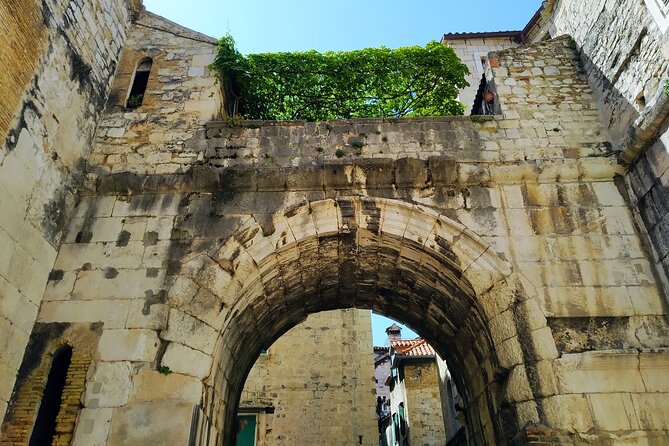
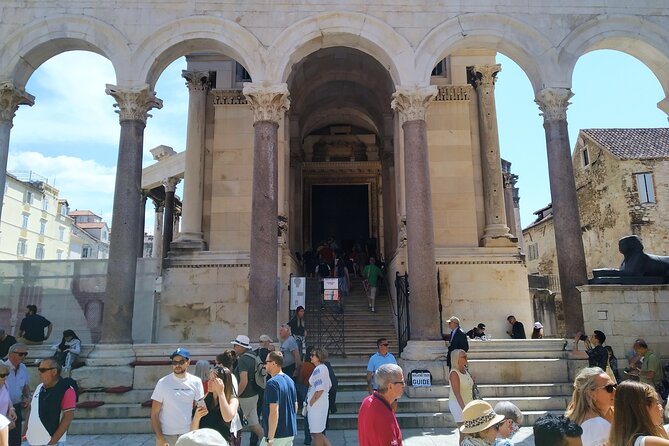
Another stop takes you to the Temple of Jupiter, known as one of the best preserved late Roman temples in the world. The location is tied to symbolism. It was chosen to express the divine connection between Emperor Diocletian and Jupiter, the sky-and-thunder god and king of the gods.
What I like here is the clear explanation of how the building’s meaning shifted. During the Middle Ages, the temple was converted into a baptistery dedicated to St. John the Baptist. That is the theme of Split in one example: old forms reused, new beliefs layered on top.
You do not get entry included here either, so your plan should account for additional tickets if you want to go deeper. But even from the outside, the story your guide gives makes the site feel intentional, not accidental.
Vestibulum of Diocletian and the idea of private space
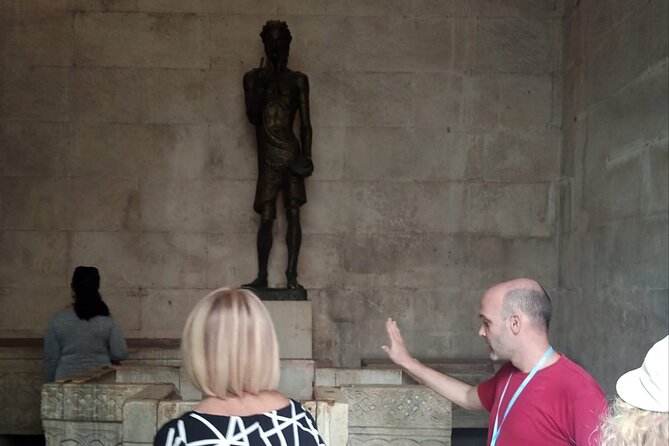
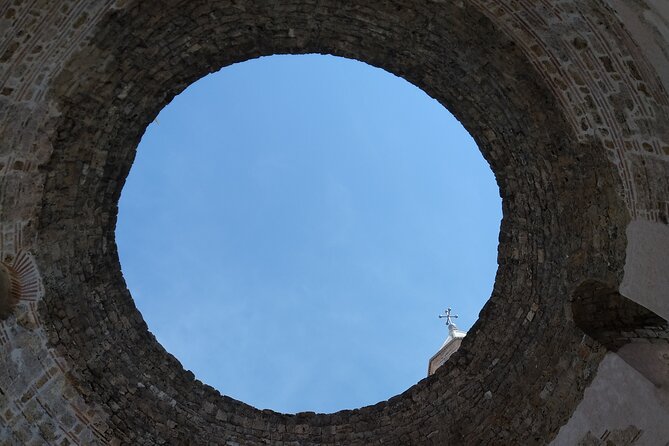
Next comes the Vestibulum, the pre-entrance to Diocletian’s private chambers. This stop is less about a dramatic facade and more about function and design.
Your guide explains what it looked like and what it was for, then you check up on the Triclinium from this area. In practice, this is a great pause from the open squares because it nudges you to think about who had access and what rooms were designed for.
If you ever wondered why palace layouts feel both strict and surprising, this is the moment. Private space in ancient palaces was not just about luxury. It was about control and rhythm, moving people where you wanted them, when you wanted them.
Riva Harbor: the promenade that connects locals and the Palace
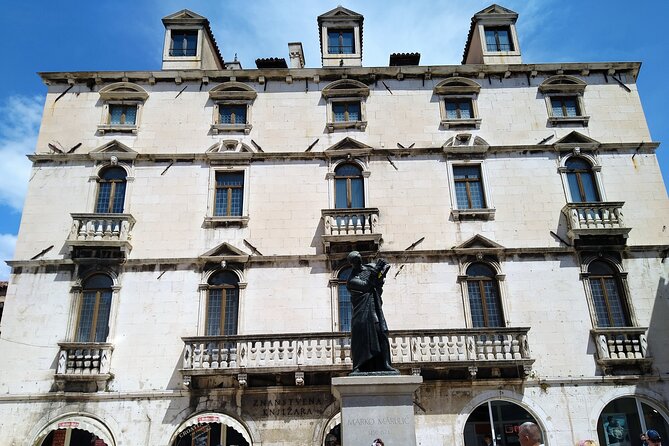
Then you move to Riva Harbor, the main city promenade and a meeting point for locals and visitors. It is the perfect transition spot. You get the busy, modern street feeling, and at the same time you can see the southern wall of Diocletian’s Palace.
The guide also explains how Riva was built over centuries and why it became central for locals. This matters because it shows how the city kept working after the Romans. The harbor is where the palace meets the everyday world, so you stop seeing the palace as a museum piece.
If you want practical value, this is it. You learn what direction to look and how to place the Palace in relation to the water, which makes the rest of your time in Split easier.
Fruit Square and Pjaca: two squares with different vibes
Next is Fruit’s Square (Trg Brace Radic), just outside the palace area. This square is known for its picturesque feel, and it is dominated by remains of a 15th century Venetian fort.
Squares like this are easy to skim if you do not know what you are looking for. The tour helps by pointing out the significant monument in the middle and explaining what surrounded it. It turns a quick stop into a “now I get it” moment.
After that, you reach Pjaca, the main square outside the western wall of the palace. Pjaca is described as the main square of the city since medieval times, with a 14th century town hall visible there along with other interesting structures.
What I like about covering both Fruit Square and Pjaca in one stretch is the contrast. One feels tied to a specific historical structure, while the other feels like the long-running public heart of town. Put together, you get a sense of how Split made space for community life around its Roman base.
Gregory of Nin statue: the landmark, the legend, and the toe trick
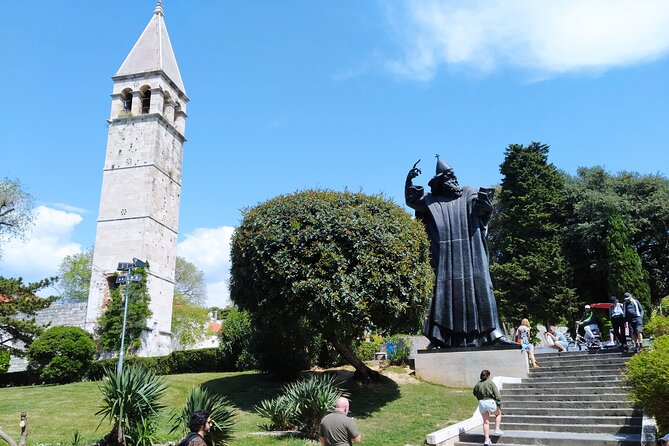
No Split old-town story feels complete without the Grgur Ninski Statue. This landmark is recognizable from far away, and your guide tells the story behind Gregory of Nin, including his highest monument in Split dedicated to him and who created the work.
The sculptor is Ivan Mestrovic, one of the most famous Croatian sculptors. That is a big name to connect to the Roman-era walking route you just did, because it shows how Split kept shaping its identity long after Roman times.
And yes, you will hear about the old luck ritual: rub the statue’s toe for good luck. It sounds silly until you see how many people do it while chatting and taking photos. It is one of those tiny moments that makes the history feel human.
Time, tickets, and what the price covers in real terms
The tour costs $238.28 per group, up to 10 people, and it runs about 1 hour 30 minutes to 2 hours. That group price is the biggest factor in value. If you are traveling with friends or family, the cost per person drops fast. If you are solo, you are paying the full group rate, so you will want to be sure you really value a guided, history-focused walk.
Most of the key stops are described as free admission to view, but two important ones are not included: the Cathedral of St. Domnius and the Temple of Jupiter. Your tour still gives you the explanation and what you need to notice, but plan for extra tickets if you want to go inside or access them fully.
Also, this is a “good weather” kind of walk. If the forecast looks rough, cancellation or rescheduling can happen. That is worth keeping in mind in shoulder season.
Who this tour is best for
This tour is a great fit if you want to understand Split fast and accurately, without hopping between far-flung locations. If you like walking and you enjoy explanations that connect buildings to everyday life, you will probably love it.
It is also good for people who like asking questions but hate getting stuck in a big group. With up to 10 people, the pace stays flexible enough to talk, not just listen.
If you hate crowds and you want your day in Split to feel planned, this private format helps. If you prefer very long museum visits or deep interior time, you might find the length short, but it is designed for the “get the bearings fast” goal.
Should you book this private history tour in Split?
Book it if you want a clear path through Diocletian’s Palace, a guide who can explain the shift from Roman power to later Christian changes, and a walk that ends with you understanding how Riva, Fruit Square, and Pjaca fit together.
Skip it or reconsider if you only want interior access and do not want to plan for extra tickets at the cathedral and Jupiter Temple. Also, if you are traveling when weather is often bad for walking, have a backup plan for rescheduling.
If you want a smart, compact way to read Split like a living map, this is one of the better choices you can make early in your trip.
FAQ
How long is the Private History tour in Split?
It runs about 1 hour 30 minutes to 2 hours.
What is the price for the tour?
The price is $238.28 per group, with up to 10 people.
Where do we meet, and where does the tour end?
You meet at Ul. kralja Tomislava 15, 21000, Split, Croatia. The tour ends back at the meeting point.
Is this tour private or shared?
It is a private tour/activity. Only your group participates.
Do I need to buy tickets for every stop?
Many stops are listed as free admission, but tickets are not included for the Cathedral of Saint Domnius and the Temple of Jupiter.
What if the weather is poor?
The experience requires good weather. If it is canceled due to poor weather, you are offered a different date or a full refund.
Fresh options around Split
- Walking Tour Split★ 4.7 · 61 reviews
- Unique vintage Tomos moped tour Split – Back to the ’80s★ 4.8 · 17 reviews
- Essential Diocletian’s Palace Tour for First-Time Visitors★ 4.8 · 19 reviews
- Split: Trogir Open Top Bus Trip + Free Split Walking Tour★ 4.1 · 17 reviews
- Ranch 22 Podstrana, ” Horse riding 12 km from SPLIT “★ 4.5 · 79 reviews
- Zinfandel Wine Tasting & Storytelling with Dalmatian Food★ 5.0 · 20 reviews
- 1 st Waterbike Safari in the World★ 5.0 · 23 reviews
- Full-Day Quad and Wild Horses Safari in Livno from Split★ 5.0 · 12 reviews
Historical Tours, compared.
Walking Tour of Split with a ‘Magister’ of History
Read our review →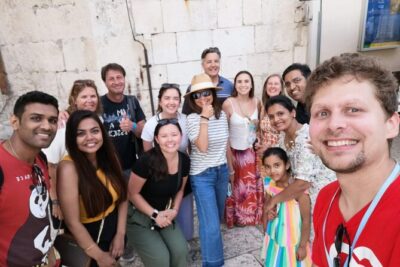
Split History and Gastro Small-Group Tour with Food and Drinks
Read our review →
PREMIUM Emperor’s Walking Tour for History Lovers + Museum
Read our review →
Local History and Culture 90-Minute Walking Tour
Read our review →
Historical & Gastro Treasures Tour with Green Market
Read our review →Browse the lists this tour appears in